The Other meaning of a dream with the train that never stops
Perspective: other
Your Dream
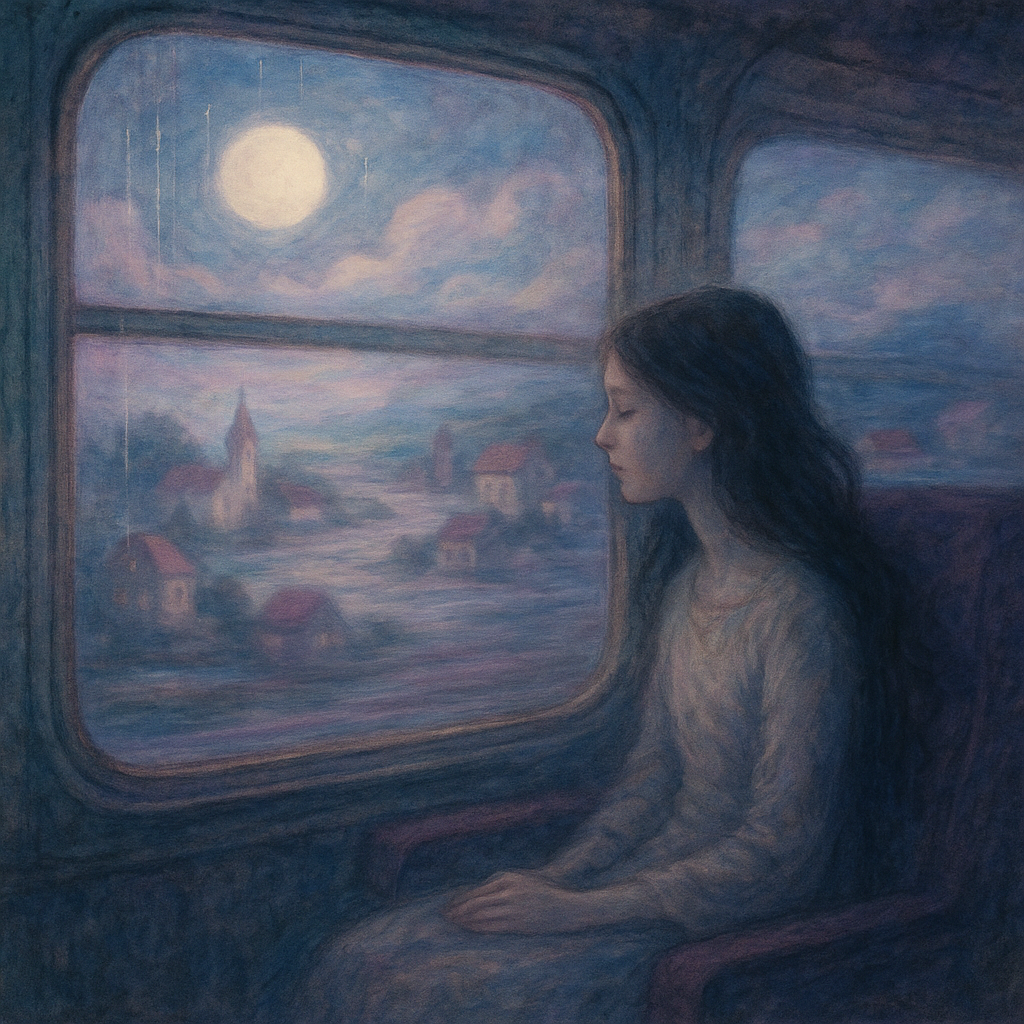
Last night I was on a train that somehow never stopped. I don’t even remember getting on, which is funny, but there I was, sitting by a window streaked with old rain, watching unfamiliar towns whip by. The whole carriage smelled a little like burnt toast. It was crowded, but weirdly quiet, except for the endless, monotonous clacking of the tracks. I noticed the guy across the aisle was peeling the label off a bottle of iced tea—tiny green flakes left on his jeans. I tried to read a paperback I’d stuffed in my bag (something about gardening), but every time I looked away from the window, I felt a wave of unease, like I might miss my stop—even though it slowly became obvious we weren’t stopping anywhere. After a while, I thought about asking the conductor when we’d arrive, but I couldn’t find any staff. Instead, some older woman in a bright red raincoat sat beside me, even though there were plenty of empty seats by then. She started talking about her son and his dog, but her words blurred, and I couldn’t quite catch them. The seats were sticky, though—not uncomfortably so, just a kind of faint tackiness, maybe soda someone had spilled ages ago. The strangest thing was how the train sped up as it went through stations, blurring signs and faces on the platforms until it all just looked like dripping paint. At some point, I realized I had no idea where my ticket was, or even where I was supposed to be going.
Your Dream, Revealed
A calm, guided space to explore what this dream may be reflecting back to you.
Dream Overview
This dream unfolds in the perpetual motion of a train that never stops, setting a tone of uneasy momentum and disconnection. The emotional atmosphere is quietly tense, marked by the juxtaposition of a crowded carriage and a pervasive, unnatural silence broken only by the relentless clack of the tracks. At its heart is a persistent uncertainty—never remembering how you began this journey, nor where you are going or meant to end up. Objects and actions, like the window streaked with rain and the stranger peeling a label, are noticed in sharp detail, yet these observations only deepen your sense of being an outsider to your own experience. The central conflict is your growing discomfort with passivity and the inability to take control or even locate someone in charge, as shown by your failed search for the conductor. Distinctive sensory details—the burnt toast aroma, sticky seats, and blurring scenery—create a physical texture that makes this dream feel lived-in, not just witnessed. There is a subtle tension between your attempts at distraction (the gardening book) and the magnetic pull of the unknown landscape outside, suggesting a struggle between comforting routine and the anxiety of missed opportunities. Above all, this dream is marked by a haunting absence of arrival, making every attempt at orientation feel both necessary and impossible.
The dream opens with an odd dislocation—you find yourself already on a train, with no memory of how you arrived, creating an immediate sense of mystery and passivity. As the journey continues, the external world rushes by in a blur, towns and stations rendered indistinct by speed and rain, establishing a mood of fleeting encounters and missed details. You attempt grounding yourself with familiar actions, like reading a gardening book, but these efforts are continually thwarted by a gnawing unease that keeps drawing your attention back to the window and the relentless motion outside. The realization that the train never stops becomes central, intensifying your anxiety and prompting you to seek reassurance from authority (the conductor), only to find none. The arrival of the older woman marks a subtle shift, introducing the possibility of connection or meaning, but her disjointed communication only deepens your sense of isolation, especially as the carriage's physical discomforts become more noticeable. The dream crescendos as the train speeds through stations, erasing any hope of arrival or orientation, until you are left confronting the loss of your ticket and your destination, encapsulating the core tension between movement and directionlessness.
Key Findings
• The train's endless movement with no stops mirrors a feeling of being caught in a process without clear purpose or endpoint. • Your unease intensifies when you look away from the window, highlighting a fear of missing out or losing orientation. • The conductor's absence and the loss of your ticket reinforce a sense of disempowerment and lack of agency. • The older woman’s blurred speech signifies missed or inaccessible wisdom or guidance at a moment when you seek direction. • The physical discomforts—the burnt toast smell and sticky seats—add a layer of low-level distress that colors the entire experience.
Symbol Interpretation
Never-stopping train
A sense of life progressing beyond your conscious control, with uncertainty about origins and destination.
Rain-streaked window
A barrier between you and the outside world, distorting what’s beyond and making it feel unreachable.
Burnt toast smell
A subtle, pervasive discomfort—small but persistent reminders that all is not well.
Peeling label
A nervous or compulsive action reflecting attempts to manage anxiety or boredom by focusing on small details.
Lost ticket
A lack of proof or reassurance about your place or purpose, contributing to a deep uncertainty.
Older woman in red raincoat
An ambiguous offer of comfort or wisdom that you cannot fully receive or understand.
Emotional Landscape
A quiet but persistent sense of unease threads through every moment of the dream, rooted in the train’s endless motion and the unfamiliarity of the passing landscape. This unease sharpens into anxiety whenever you try to distract yourself, as seen when looking away from the window or attempting to read, only to feel you might miss something crucial. The mood is tinged with a subtle loneliness, intensified by the silence of the crowd and the inaccessibility of the older woman’s speech, making every attempt at connection feel muffled or incomplete. The physical sensations—the burnt toast smell and sticky seats—are not overwhelming, but they serve as constant reminders that you are not at ease, deepening the emotional texture of the dream. By the end, the absence of a ticket and the impossibility of finding staff crystallize your emotions into a profound uncertainty, bordering on resignation, as you acknowledge the lack of control over your journey.
Psychological Insight
Your motivation throughout the dream seems to be a search for orientation and reassurance, yet every attempt is subtly undermined by circumstances beyond your control. The moment you try to read or otherwise distract yourself, you’re pulled back by anxiety, suggesting an underlying fear of missing essential information or opportunities. The repetitive, monotonous sounds and actions—clacking tracks, peeling labels—point to a psychological state of waiting, a kind of suspended agency where routine replaces active engagement. Avoidance is present in your reluctance to engage directly with the other passengers, and the blurring speech of the woman in red hints at a difficulty in receiving guidance or parsing meaning from those around you. The gradual realization that you lack both a ticket and a destination is gently confronting: it reflects a deeper uncertainty about your own direction or sense of purpose at this moment in your life.
Spiritual Perspective
Given your self-identified 'other' spiritual or belief orientation, this dream does not rely on overt spiritual symbols but instead evokes existential questions about control, belonging, and the search for meaning. The endless train ride is neither a punishment nor a quest; it becomes a kind of liminal space, a suspended reality where the usual markers of progress and purpose (stops, destinations, authority figures) are absent or inaccessible. The blurred communication from the woman in the red raincoat can be seen as a nod to the difficulty of extracting wisdom or comfort from sources that do not fit conventional categories, mirroring your own belief stance. In this light, the dream seems less about finding external answers and more about sitting with ambiguity—accepting the discomfort of not knowing, and perhaps beginning to question the need for certainty itself.
Integrative Insight
Drawing together these threads, your dream vividly illustrates a moment in life where direction feels out of reach, and the usual ways of grounding yourself no longer suffice. The quiet discomforts, blurred guidance, and relentless forward motion reflect an internal state of questioning rather than conclusion, inviting you to notice how you respond when familiar structures fall away. Instead of striving to control or fix, the dream gently confronts you with the possibility of attending to discomfort and uncertainty as valid experiences in themselves. This is not a call to despair, but an invitation to recognize the peculiar clarity that can surface when you stop searching for arrival and start being present with the journey. The dream’s most memorable lesson is that sometimes, the only wisdom available is to notice the ride, even when you cannot see the destination.
Reflection Questions
- What do you most fear missing when you look away from the window, and how does that echo choices you avoid making in waking life?
- How do you typically respond when guidance or reassurance—like the absent conductor or the woman's blurred words—feels out of reach?
- If you imagined sitting with the discomforts (the burnt toast smell, sticky seats) rather than resisting them, what unexpected insights might emerge about your current path?