A Buddhist take on the dream of the quiet hospital corridor
Perspective: buddhist
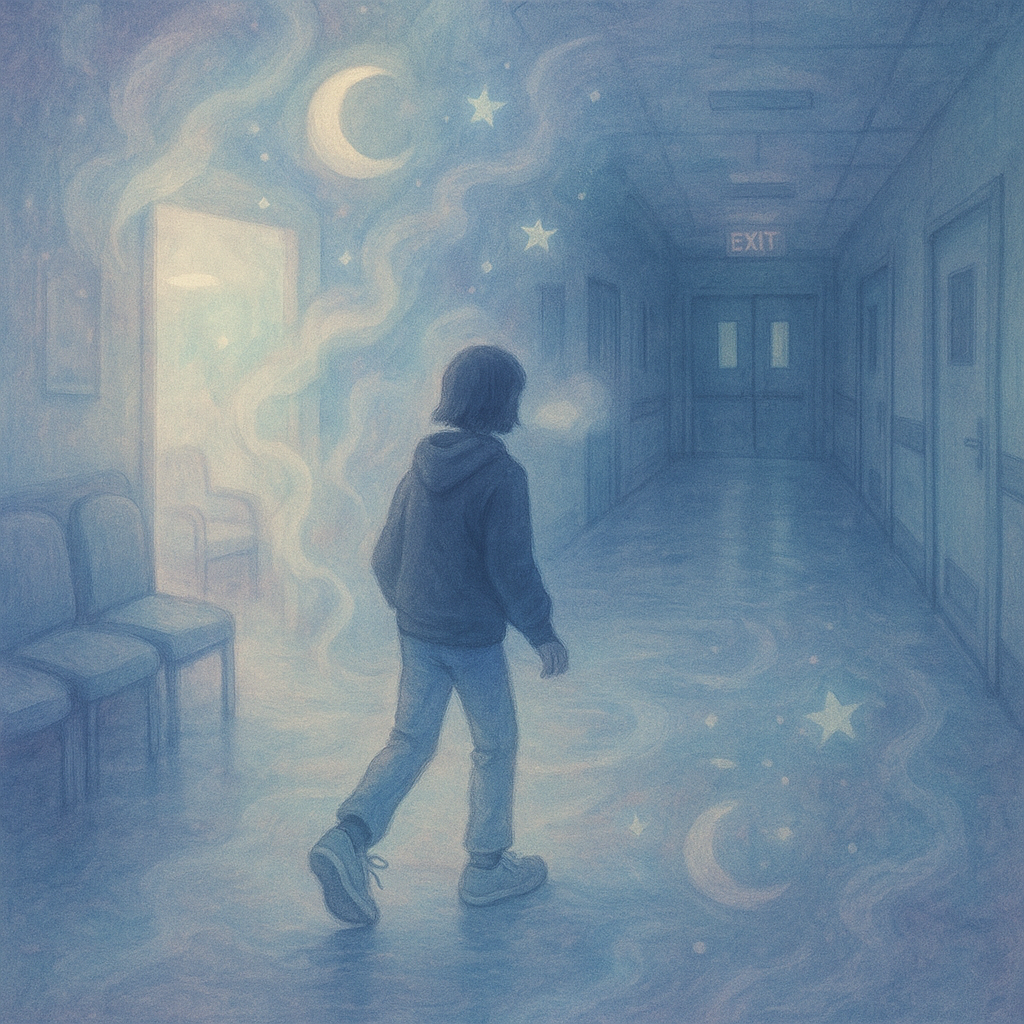
Your Dream
I wandered out of some waiting room and found myself on a strange hospital floor—it was so quiet it felt like I could hear my own breathing echoing. I remember my sneakers squeaking a little as I walked, which made me instantly self-conscious, like I was breaking some important silence. The overhead lights hummed, that harsh, clinical glow making everything look pale, even the faded blue linoleum tiles under my feet. For some reason, I was carrying my old green backpack, the one with the frayed zipper that always catches when I’m rushing. I kept fiddling with it, almost like I needed to prove to myself that I still existed, or maybe just keep my hands busy. Along both sides of the corridor, doors were half-open, some of them swinging slightly, like someone had just passed through a moment before. There were these old, yellowed signs taped up—handwritten reminders about visiting hours and mask policies—and the smell of antiseptic really clung to the air, almost making me dizzy. I never saw any patients or nurses, just an empty wheelchair parked near a water fountain (which was dribbling onto the floor, by the way; I remember thinking someone should put a sign there). Somewhere in the distance, a phone rang and then stopped, and I couldn’t tell if it was further away or just very muffled. I kept walking, but the hallway never seemed to end. I passed a clock mounted a little crooked above a supply closet, but the hands were spinning too fast to read. I tried to text someone—my sister, I think—but my phone just showed an endless loading circle. It felt urgent, like there was something I was supposed to do or remember, but the more I tried to focus, the more everything slipped away, and then I woke up with my heart pounding.
Your Dream, Revealed
A calm, guided space to explore what this dream may be reflecting back to you.
Dream Overview
This dream begins with an unmoored exit from a waiting room, immediately introducing an atmosphere of dislocation and subdued tension. The hospital floor is portrayed as hauntingly quiet, amplifying the dreamer's acute self-awareness and sense of intrusion, especially marked by the squeaking sneakers. Central to the experience is the old green backpack, a tangible anchor to the dreamer's past, serving both as a comfort and a source of preoccupation. The corridor lined with half-open, swinging doors evokes uncertainty and proximity to unseen presences, while the faded, clinical visuals and the antiseptic smell further reinforce a liminal, almost suspended reality. The absence of people and the presence of neglected objects, like the dripping water fountain and empty wheelchair, turn the hospital into a landscape of waiting and neglect rather than healing. The crooked clock with spinning hands and the endlessly loading phone highlight a profound frustration with time, communication, and the inability to grasp what feels urgent yet elusive. What makes this dream distinctive is the way it weaves physical detail with existential suspense, exposing a deeply personal struggle to locate oneself in the midst of uncertainty and the pressure to 'do' or 'remember' something just out of reach.
The dream unfolds in a series of subtle yet distinct phases, beginning with the transition from a waiting room to a starkly empty hospital floor. This initial movement sets a tone of isolation and uncertainty, as the dreamer becomes hyper-aware of their own minor disruptions in an otherwise silent space. As the dreamer walks, the presence of familiar but worn personal items, like the green backpack, introduces a thread of nostalgia and physical self-soothing, contrasting sharply with the environment's impersonal chill.
The corridor phase is marked by repetition and ambiguity: half-open doors suggest both invitation and threat, while the faded signs and antiseptic air create a sense of stasis and neglect. The absence of other people transforms the hospital into a stage for the dreamer's inner drama, where every unattended object hints at stories left unfinished.
The latter part of the dream intensifies urgency and disorientation. The spinning clock and malfunctioning phone escalate the helplessness, as time and communication become unreliable. The narrative closes not with resolution, but with a building crescendo of anxiety—the dreamer's pounding heart upon waking reflecting unresolved tension and a deep yearning for clarity or comfort that remains unmet.
Key Findings
• The echoing silence and self-conscious squeak of sneakers reveal a fear of being exposed or out of place when alone. • The frayed green backpack is clutched compulsively, hinting at a longing for familiarity or self-affirmation amid disorientation. • Unattended objects—the empty wheelchair and leaking fountain—suggest anxieties about neglect, both given and received. • The spinning hands of the crooked clock and the endless loading phone intensify the dream's sense of urgency and helplessness. • The corridor's endlessness, lined with half-open doors, embodies an unresolved tension between possibility and paralysis.
Symbol Interpretation
Old Green Backpack
This backpack symbolizes a persistent need for self-reassurance and a link to earlier aspects of identity, especially in unfamiliar or stressful contexts.
Endless Hospital Corridor
The corridor manifests the dreamer's experience of prolonged uncertainty and the sense of being trapped in liminality, with no clear direction or resolution.
Crooked, Spinning Clock
This clock symbolizes distorted perception of time, anxiety about deadlines, and the impossibility of grounding oneself in the present moment.
Empty Wheelchair by the Dripping Fountain
This pairing suggests vulnerability and unattended needs, both physical and emotional, alongside a subtle critique of neglect or avoidance.
Endlessly Loading Phone
The phone represents frustrated attempts at connection, and the pain of not being able to reach out or be reached when it matters.
Emotional Landscape
A pervasive sense of alienation underpins the dream, sharpened by the echoing silence and the dreamer's acute self-consciousness about making noise. This emotional edge is less about fear and more about the discomfort of being seen—or heard—when one feels fundamentally alone.
The backpack, repeatedly handled, reveals a quieter anxiety: the need to hold onto something familiar when the environment offers nothing reassuring. This compulsive gesture is both a solace and a symptom, revealing the strain of trying to stay anchored in the face of uncertainty.
Neglected objects (wheelchair, leaking fountain) stir up feelings of abandonment or being overlooked, as well as subtle guilt or responsibility; the thought that 'someone should put a sign there' hints at the dreamer's empathy, even in distress. There is also an undercurrent of frustration and longing for connection, crystallized in the failed attempt to contact the dreamer's sister, which is met only with technological futility.
The dream's final emotion—a pounding heart upon waking—captures the cumulative effect of these layers: a blend of urgency, powerlessness, and a haunting sense that something vital remains just out of reach.
Psychological Insight
The dreamer's wandering out of the waiting room signals a break from passive anticipation to active searching, but the journey is hampered by the environment's endless sameness and lack of human presence. This suggests a psychological state torn between the desire to move forward and the fear of never finding resolution.
Clutching the backpack and focusing on its frayed zipper point to a defensive maneuver: when external circumstances feel overwhelming, the dreamer retreats to familiar rituals, even if those are imperfect and frustrating. This gesture reveals a reluctance to fully face the void or ambiguity of the present moment.
Attempts to communicate—texting the sister—are blocked by external forces (the phone's endless loading), echoing an internalized belief that efforts to reach out will be met with delay or disappointment. The spinning clock and endless corridor further externalize a psychological experience of time as slippery and uncontrollable, compounding the sense of helplessness.
A gently confronting insight emerges: the dreamer appears to oscillate between seeking connection and engaging in self-soothing avoidance, hinting at an internal conflict between facing difficult feelings directly and finding ways to temporarily escape them.
Spiritual Perspective
Within a Buddhist context, the hospital's liminality and the endless corridor resonate with themes of impermanence and the suffering inherent in clinging to certainty or control. The dream's relentless movement—without arrival—mirrors the restlessness of the mind when attached to outcomes or haunted by unresolved intentions.
The urge to text the sister and the frustration of the spinning clock both reflect the Buddhist notion of craving and the suffering that arises from wanting things to be different than they are. The dream subtly exposes how even familiar comforts (the backpack) cannot ultimately provide lasting refuge when the root unease remains unaddressed.
In this light, the dream's emptiness is not just absence but invitation—a call to recognize the futility of grasping for stability in transient forms, and perhaps, to soften into the uncertainty rather than resist it.
Integrative Insight
Synthesizing these layers reveals a dreamer navigating the tension between longing for connection and the impulse to retreat into safety. The hospital, stripped of caregivers and patients, becomes a stage for confronting what persists when external supports are absent and familiar routines lose their power to comfort. The urgent yet fruitless attempts to communicate and orient oneself highlight how the real discomfort lies not in the environment, but in the refusal to surrender to uncertainty.
There is a quietly radical invitation in this dream: to notice, with compassion, how much energy is spent resisting the unknown, and to consider what might be possible if the dreamer could pause—not rush—within the endless corridor. In the moment where the clock spins and the phone loads, the most courageous act may be to simply breathe and witness.
This dream whispers: your deepest discomfort is less about where you are, and more about how tightly you hold onto what you cannot control.
Reflection Questions
- When you felt your sneakers squeak and became self-conscious, what core fear surfaced for you in that silence?
- What does the act of fiddling with your old green backpack mean to you now, especially in moments when you feel unmoored?
- How do you respond when your attempts to reach out—like texting your sister—are met with delay or uncertainty in waking life?