A Buddhist take on the dream of the friend I could not reach
Perspective: buddhist
Your Dream
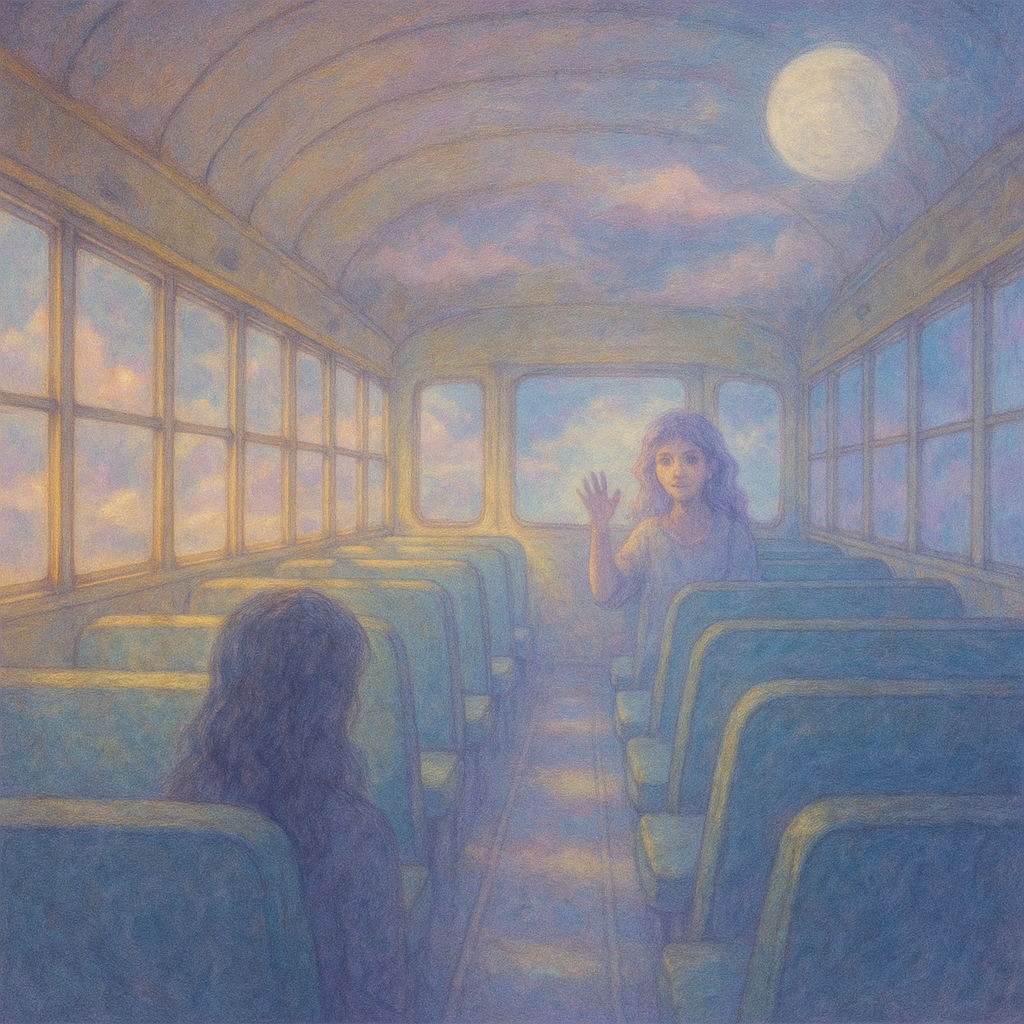
I’m on the old yellow school bus again, the kind that smells faintly of vinyl and crumpled paper wrappers, but there’s no one in any of the seats except for me and Leila. She waves at me from the far end, grinning like before, hair swinging over her shoulder, but no matter how many rows I pass, I can’t get any closer. The aisle keeps stretching, doubling itself each time I think I’m almost there. I call out to her, but my voice comes out thin, squeezed flat by the humming of the bus engine, which is so loud it rattles my teeth. I try to move faster—almost run—but my legs move as if I’m underwater. Out the window, the world is all dusk and flickering gas-station lights, those flickery orange halos you only see late at night on long drives. I notice my backpack at my feet, unzipped, and some of my pens are rolling around on the dirty rubber floor. For a moment, I think maybe if I just pick them up and zip it closed, I’ll wake up, but instead the bus turns sharply and Leila’s face blurs, her voice echoing with words I can’t really hear. I feel this heavy squeeze in my chest, a kind of panic mixed with regret, because I can’t shake the sense that I missed something important or left her waiting too long.
Your Dream, Revealed
A calm, guided space to explore what this dream may be reflecting back to you.
Dream Overview
This dream unfolds within the contained, almost suspended world of an old yellow school bus, where time stretches and the familiar becomes elusive. The emotional tone is marked by yearning and frustration, especially as the dreamer strives to reach Leila, who remains always out of reach despite persistent effort. A central tension emerges from the endless, doubling aisle—each step forward only increases the distance—creating a sense of futility and disconnection. The hum of the engine, so loud it drowns out the dreamer’s voice, underscores an inner struggle to be heard or understood within a cacophony of internal noise. The scattered pens and unzipped backpack introduce themes of disarray and lost readiness, hinting at unfinished business or unexpressed thoughts. The world glimpsed outside is liminal: dusk, gas-station halos, a setting that feels both transient and untethered. What makes this dream distinctive is its vivid layering of sensory details and the poignant sense that some essential connection—represented by Leila—remains stubbornly just out of reach, amplifying both regret and longing.
The dream begins with the dreamer alone on the nostalgic yellow school bus, a setting that immediately evokes the past and a sense of being transported but not in control. The initial interaction—Leila’s distant, waving presence—creates a hopeful pull, but the dream quickly pivots as each attempt to approach her only makes the journey longer and more daunting. The progression from walking to almost running, paired with the underwater sensation, marks a shift from determination to mounting frustration and helplessness.
As the dreamer calls out, the auditory environment shifts: the engine’s roar dominates, erasing the dreamer's voice and deepening the sense of isolation. This sonic barrier transforms the dream from a pursuit to a struggle against overwhelming forces. The narrative then narrows in on the pens and backpack, an intimate moment of focus on disarray and the fleeting hope that regaining control over small details might restore equilibrium or even end the dream.
The climax arrives as the bus jerks into a turn, Leila’s image blurring and her voice reduced to echoes. This sudden, disorienting movement marks the final loss of connection, leaving the dreamer with a physical and emotional squeeze in the chest—panic, regret, and the inescapable conviction that something vital has been missed or lost along the way.
Key Findings
• The endlessly stretching aisle highlights a pattern of effort that leads to greater distance rather than closeness. • The overpowering engine noise and the dreamer’s thin, flattened voice suggest a struggle to communicate or express oneself. • Leila’s unreachable presence points to a relationship or part of the self that feels lost or inaccessible. • Scattered pens and an open backpack evoke a sense of vulnerability and lack of preparedness. • The flickering lights outside the window reinforce a mood of transience and the difficulty of finding clarity when moving through uncertain territory.
Symbol Interpretation
Old Yellow School Bus
Represents a formative environment or journey from the past, possibly connected to learning or transition.
Leila
Embodies someone cherished or a lost aspect of the dreamer's own history, associated with both joy and regret.
Stretching Aisle
Symbolizes obstacles that intensify with effort, leading to increased separation rather than resolution.
Overpowering Engine Noise
Represents internal or external forces that overwhelm self-expression, leading to feelings of powerlessness.
Unzipped Backpack and Rolling Pens
Suggests unfinished tasks, lost control, or anxieties about not being ready or equipped for what’s needed.
Flickering Gas-Station Lights at Dusk
Represents the uncertain, transitional space the dreamer inhabits, where the path forward is unclear.
Emotional Landscape
The primary emotional current is longing, threaded through the repeated attempts to cross the aisle and reach Leila. Each step intensifies hope, but this hope is met with the counterweight of growing helplessness as the aisle stretches out, turning desire into frustration. This frustration is not just cognitive but deeply physical—legs moving as if underwater, a sensation of being slowed by unseen forces.
Isolation is underscored by the empty seats and the muffled, ineffective voice. The inability to communicate, even as the dreamer calls out, deepens the feeling of being cut off—not only from Leila but from the possibility of meaningful connection. The heavy squeeze in the chest at the dream’s end merges panic with regret, suggesting emotional stakes that run deeper than the surface narrative.
A subtler layer is introduced by the pens and backpack: vulnerability and anxiety about readiness, as if the dreamer is caught unprepared in a moment that demands presence. The dusk outside and flickering lights enhance the emotional mood, coloring the dream with uncertainty and the melancholy that often comes at the threshold between day and night.
Psychological Insight
The dreamer’s repeated attempts to reach Leila suggest a persistent desire to reconnect with a person, moment, or quality that feels irretrievably distant. The doubling aisle is not merely an obstacle; it reflects a pattern where effort itself seems to increase the distance, hinting at a possible fear that striving too hard in relationships or personal goals only leads to disappointment or further separation.
The overpowering engine noise may represent internalized criticism, anxiety, or external pressures that drown out the dreamer’s authentic voice. The frustration of not being heard points to a deeper conflict around self-expression and the struggle to assert needs or truths in the face of overwhelming distractions or resistance.
The scattered pens and open backpack evoke a sense of being unprepared or unable to gather one’s resources at a critical moment, perhaps mirroring a real-life fear of not having what it takes when it matters most. The act of trying to fix this small chaos in the dream, only to be swept away by the bus’s turn, suggests an impulse to control the controllable when the larger situation feels hopeless.
There is a gently confronting insight in the way the dreamer clings to the hope that fixing small details might change the outcome, even as the larger dynamic (the endless aisle, the overpowering noise) persists. This may reflect a reluctance to face the broader emotional reality: some losses or separations cannot be solved by minor adjustments.
Spiritual Perspective
From a Buddhist perspective, the dream’s endlessly stretching aisle and the persistent effort to reach Leila can be seen as an enactment of attachment and suffering—the more one grasps, the more the object of desire recedes. The overwhelming noise and the futility of calling out may parallel the mental noise that clouds awareness, making it difficult to access clarity or direct experience.
The scattered pens and open bag introduce the Buddhist theme of mindfulness: the realization that small, neglected aspects of life often signal deeper unrest. The dream’s liminal setting—dusk and flickering lights—mirrors the Buddhist teaching on impermanence and the ever-shifting nature of reality. The dream does not offer closure, but instead invites gentle observation of longing, regret, and the pull between striving and letting go.
Integrative Insight
This dream brings into focus a beautifully painful paradox: the closer you move toward what you miss or desire, the further it seems to slip away. The details—stretching aisle, Leila’s blurred face, rolling pens—coalesce into a portrait of longing shaped as much by internal resistance and regret as by any external barrier. The emotional squeeze, felt so viscerally in the chest, is both a warning and a call: an invitation to recognize how the urge to close every gap or fix every detail can itself deepen the sense of separation.
From a place of quiet witnessing, the dream suggests that true connection or resolution may not come from striving or control, but from accepting the spaces between self and other, past and present. The memory of Leila—part joy, part regret—can be honored not by chasing, but by pausing to fully feel what remains. Sometimes, the effort to reach is the very thing that keeps us apart.
Reflection Questions
- When in your waking life have you felt that the harder you try to reach someone, the more distant they become?
- What small, scattered details—like the pens in your backpack—might be drawing your attention away from larger unresolved feelings?
- In what ways does the noise of daily life drown out your authentic voice, and what would it mean to sit quietly with what cannot be said?