The Other meaning of a dream with the lost suitcase
Perspective: other
Your Dream
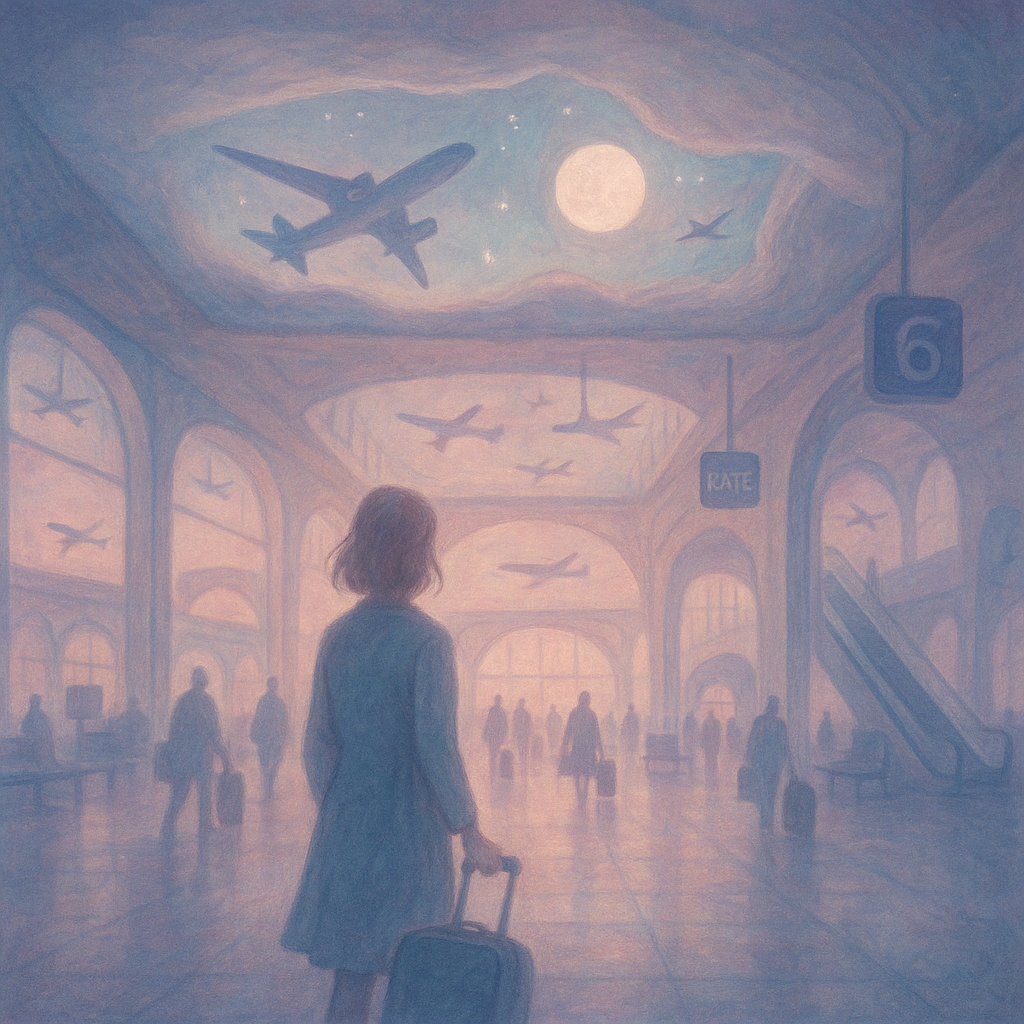
Last night I dreamt I was in some sort of airport, but it wasn’t like any airport I’ve actually been to—everything was both grand and cramped at the same time, with ceilings so low in one corridor I had to hunch, then suddenly opening into huge, echoing halls full of neon signs. I remember dragging my green suitcase behind me, the squeaky wheel making that annoying chirping noise it always does, and feeling a bit embarrassed because everyone was staring. It smelled faintly of microwaved pizza, like the food court at the train station I used to go to after school. But the screens overhead only showed clocks and gibberish letters, nothing I could make out. At some point, I set my suitcase down by a chair to check my phone—it was an old flip phone from high school for some reason, and I couldn’t find the right button to unlock it. I looked up, just for a second (someone was unwrapping a muffin near me, I remember the crinkling plastic), and my suitcase was gone. In the dream, there was this weird, sinking feeling in my stomach—sort of like the panic when you lose your wallet, but muted, like it was underwater. I frantically searched the area, pushing past people with stacks of papers and some guy trying to sell newspapers (who sells newspapers at an airport, really?). The walls started shifting, the chairs turned into benches, and suddenly I was outside, holding only the rough plastic handle from my suitcase, as if it had snapped off in my hand. The dream sort of fizzled out there, but I woke up still feeling unsettled, half-convinced my actual suitcase was missing, even though I haven’t traveled in months. I think maybe it’s because I packed my gym bag last night and kept thinking about how I always forget something.
Your Dream, Revealed
A calm, guided space to explore what this dream may be reflecting back to you.
Dream Overview
This dream unfolds in a shifting, unfamiliar airport, where grandeur and claustrophobia collide, establishing an atmosphere of disorientation and unease. The emotional core is a blend of embarrassment, confusion, and muted panic, triggered by the protagonist’s green suitcase and the persistent gaze of strangers. Central tension arises from the struggle to maintain control—over belongings, technology, and even the environment itself—as everything becomes unreliable or unrecognizable. The green suitcase, squeaky wheel, and malfunctioning flip phone form a trio of personal relics, each referencing past places and times. The walls and furniture morph unexpectedly, intensifying the sense of instability and loss. Embarrassment about the suitcase and the surreal, judgmental stares from others hint at deeper anxieties about visibility and vulnerability. The dream’s vivid sensory details—chirping wheels, microwaved pizza, plastic crinkling—keep the experience grounded in memory, even as reality unravels. What makes this dream distinctive is its seamless blending of nostalgia, everyday flaws, and a quietly confronting fear of being unprepared or left behind.
The dream begins in a surreal version of an airport, where familiar expectations are subverted: the space is simultaneously grand and cramped, creating initial confusion and tension. This phase is marked by the physical struggle of hunching through low corridors, which then erupt into vast, impersonal halls. The act of dragging the green suitcase sets the stage for embarrassment and self-consciousness, as the protagonist becomes acutely aware of being observed—an emotional pivot point reinforced by the persistent squeak of the suitcase wheel.
When the dreamer pauses to check an old flip phone, the narrative slows, focusing on frustration and a subtle longing for the past. This stillness is shattered by the realization that the suitcase has vanished, introducing a surge of muted panic. The search that follows is chaotic and surreal, with shifting walls, morphing furniture, and strange figures (like the newspaper vendor) intensifying the sense of unreality.
The final phase is marked by loss and disorientation: outside the airport, the dreamer holds only the broken handle of the suitcase, signaling both an end and a sense of failure. The dream fizzles out unresolved, echoing in the waking world with lingering unease and a half-conviction that something important is truly missing.
Key Findings
• The airport’s shifting architecture signals a persistent sense of instability and unpredictability in familiar routines. • The green suitcase and its squeaky wheel expose a fear of being judged for personal imperfections in public. • The malfunctioning flip phone from high school points to an unresolved longing for simpler times or past certainty. • Losing the suitcase and ending up with only its broken handle highlights a struggle with letting go and the anxiety of incomplete preparation. • The dream’s sensory cues—smells, sounds, and fleeting embarrassment—anchor larger anxieties in real, everyday experiences.
Symbol Interpretation
Green Suitcase
Represents the dreamer’s personal baggage—both literal and emotional—along with a fear of losing control or forgetting something crucial.
Flip Phone
Symbolizes outdated tools or comfort in past identities, along with frustration at not being able to access or use them in the current context.
Neon Signs and Clocks
Highlight a confusion about direction or time, and a sense of receiving information that is impossible to decipher.
Squeaky Wheel
Embodies minor but persistent insecurities that feel disproportionately visible to others.
Broken Handle
Represents the aftermath of loss—clinging to a fragment when the whole is gone, and the inadequacy of what remains.
Emotional Landscape
Embarrassment is a dominant emotion, rooted in the suitcase’s squeaky wheel and the imagined gaze of strangers. This is not a sharp shame, but a low-level, persistent discomfort with being exposed or judged for minor imperfections. The dreamer’s anxiety is heightened by the uncertainty and unreliability of the environment—walls that shift, chairs that turn into benches—mirroring an internal fear of losing footing or stability in daily life.
A muted sense of panic arises upon discovering the suitcase is missing, but the panic is described as ‘underwater,’ suggesting a feeling of helplessness dulled by resignation or emotional fatigue. This blunted response may reflect a learned coping mechanism: bracing for loss without expecting resolution. The sensory details—the smell of microwaved pizza, the crinkle of plastic—anchor the dream in nostalgia, evoking comfort but also highlighting what is missing or out of reach.
Ultimately, the emotional residue is not devastation, but a persistent, unsettling sense of incompleteness. The dreamer wakes not in terror, but with a nagging conviction that something has slipped away—an echo of everyday anxieties about forgetting, losing, or being left behind.
Psychological Insight
The interplay between the green suitcase and the old flip phone suggests a psychological tug-of-war between past and present identities. The suitcase, packed and ready, could reflect efforts to prepare for the future, while the malfunctioning phone signals frustration with tools or habits that no longer serve. The inability to unlock the phone, and the subsequent loss of the suitcase, imply a cost to dwelling on the past: attention is diverted from what matters now, resulting in loss or missed opportunity.
The shifting, unstable environment mirrors the dreamer’s internal landscape—a mind grappling with unpredictability and the fear that familiar structures (physical or emotional) might not hold. The embarrassment about the squeaky wheel exposes a sensitivity to external judgment, perhaps reflecting a deeper wish to go unnoticed or avoid scrutiny, even for trivial flaws.
The dream’s conclusion—left with only a broken handle—suggests a struggle to accept partial loss and move forward with less than what was hoped for. There is a subtle resistance to letting go, paired with the realization that holding onto fragments is unsatisfying. This quiet confrontation with imperfection and incompleteness is both uncomfortable and necessary for growth.
Spiritual Perspective
From a cultural standpoint, the airport represents a liminal space: neither home nor destination, but a place of passage and waiting. The dream’s version of the airport, distorted and unreliable, reflects a skepticism toward spaces and routines that are supposed to offer security or predictability. The presence of outdated technology (the flip phone) and obsolete roles (the newspaper vendor) further situate the dreamer in a world where past certainties feel unhelpful or out of place.
While the dreamer’s beliefs are described as 'other,' the narrative’s focus on sensory memory and mundane anxieties grounds the experience in lived reality rather than mystical frameworks. The lack of spiritual or overtly symbolic imagery points to a practical, if uneasy, engagement with change and uncertainty. There is a quiet resignation to loss and imperfection, suggesting a belief in the necessity—but also the discomfort—of adapting to new realities.
Integrative Insight
This dream is a detailed portrait of how the past and present tangle together, creating friction in moments that should be straightforward. The dreamer’s instinct to prepare and organize collides with a stubborn sense of loss and the impossibility of ever being fully ready. Everyday anxieties—about being noticed, about losing things, about the inadequacy of old solutions—are played out in a surreal theater where nothing stays the same for long.
Yet, the discomfort is not catastrophic; it is an invitation to confront the limits of control and the inevitability of imperfection. The most memorable image—the dreamer left gripping only the broken handle—serves as a quiet challenge: to let go of fragments, and to trust that moving forward sometimes means leaving something behind. The broken handle is not a defeat, but a turning point.
You are not defined by what you have lost, but by how you adapt to what remains.
Reflection Questions
- What does the embarrassment about your suitcase’s squeaky wheel reveal about your feelings toward being seen or judged for small imperfections in public?
- How does your struggle with the old flip phone connect to your current relationship with the past—are there outdated habits or identities you find difficult to release?
- When you found yourself outside with only the broken handle, what did you feel you had truly lost—and what, if anything, did you still hold onto?