Spiritual reflections on a dream about the friend I could not reach
Perspective: spiritual
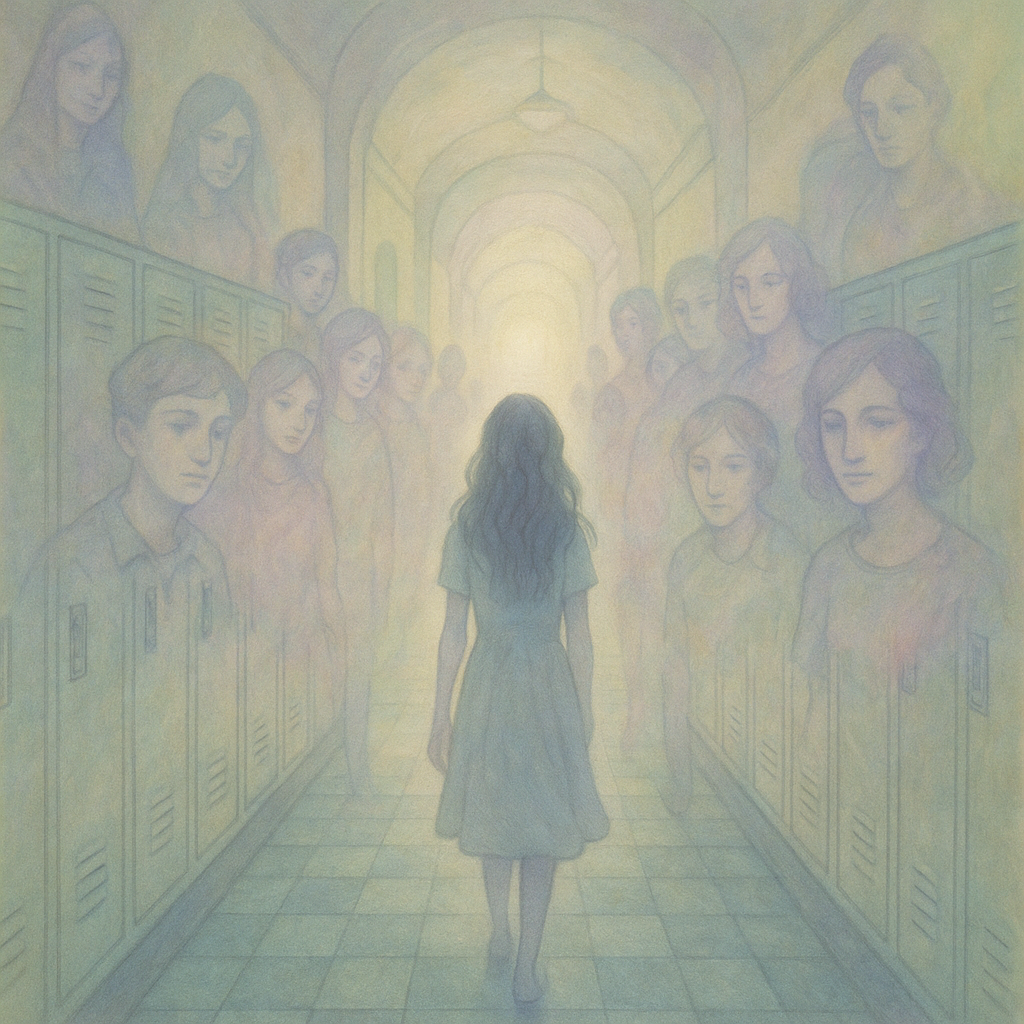
Your Dream
I was walking down a long, unfamiliar corridor, the kind that looks like the wing of an old school—pale yellow walls, greenish tile floors, rows of battered lockers. I recognized some faces in the crowd, kids from middle school, but none of them looked at me. I was searching for Sam (odd, since we haven’t really talked in years), knowing somehow he was waiting. The sound of muffled announcements echoed through tinny speakers overhead, but the words were garbled. People moved past me in waves, books clutched against their chests, brushing my arms with their jackets. It smelled faintly of pencil shavings and floor polish. I kept trying doors, thinking one of them would open to wherever Sam was. I never actually said his name out loud, but I repeated it in my head. Some doors were locked; others opened to strange places—a staff lounge filled with unused gym equipment, a bathroom with endless mirrors, even a tiny cramped supply closet where I accidentally knocked over a box of printer paper. I remember picking it up, feeling the individual sheets sticking to my fingers, worrying (ridiculously) that someone would see and be annoyed at the mess. The hallway seemed to grow longer the more I walked, as if my own footsteps were stretching it out. I could occasionally hear Sam’s laugh echoing far away, but whenever I turned in the direction of the noise, the crowd thickened, and I lost the trail. There was an edge of panic—like I was late for something important—but mixed with a weird resignation, as if part of me knew I wasn't really going to reach him. I felt my phone buzzing in my pocket, though I never took it out. When I finally did, near the end, the screen was blank, and I woke up with that feeling of unfinished business.
Your Dream, Revealed
A calm, guided space to explore what this dream may be reflecting back to you.
Dream Overview
This dream unfolds in a strangely familiar but unsettling school corridor, colored by nostalgia and a subtle sense of alienation. The emotional tone is restless and slightly anxious, heightened by the protagonist’s silent search for Sam, a figure from the past whose presence is both desired and elusive. Central tension arises from the interplay between movement—walking, searching, reaching—and the persistent feeling of not quite arriving anywhere meaningful. Key symbols such as locked doors, the endless hallway, and the blank phone screen add layers of frustration, unfinished business, and miscommunication. The dreamer’s inner conflict is shaped by both a longing for reconnection and a quiet resignation that the connection may remain out of reach. What distinguishes this dream is its intricate weaving of sensory details with personal memory, creating a space that feels simultaneously intimate and unreachable. The crowd’s indifference, the tactile anxiety over the spilled paper, and the echoing laughter all reinforce the dream’s haunting sense of being on the edge of something important yet never crossing the threshold. Ultimately, the dream stands out for the way it transforms a mundane setting into a labyrinth of unresolved feelings and unattainable closure.
The dream begins with a sense of tentative exploration, as the dreamer moves through the corridor, surrounded by the hum of familiar yet emotionally distant figures. There’s an early phase of hopefulness, spurred by the belief that Sam awaits somewhere beyond one of the many doors. As the dreamer tries door after door, the atmosphere shifts into uncertainty and mild frustration, each unexpected room reinforcing the unpredictability of the journey. The narrative grows more fraught as the hallway seems to lengthen and the crowds become thicker, introducing an element of mounting panic—especially when the dreamer hears Sam’s laughter but can’t reach him. In the final phase, resignation sets in: the protagonist’s phone buzzes insistently, but even this modern lifeline fails, leaving only a blank screen and the poignant sense that whatever needed to be resolved remains unfinished.
Key Findings
• The dreamer’s repeated attempts to find Sam, despite their estrangement in waking life, signal unresolved feelings or questions about lost connections. • Locked doors and rooms opening into strange, disjointed spaces highlight the unpredictability of memory and the difficulty of accessing certain parts of the self. • The indifferent crowd, composed of vaguely familiar faces, intensifies the dreamer’s sense of isolation and invisibility within a once-familiar environment. • The blank phone screen at the end of the dream encapsulates the frustration of missed communication and the lingering sense of unfinished business. • Recurring sensory details, like the smell of pencil shavings and the feeling of paper, anchor the dreamer in a specific time yet underscore how far they feel from genuine contact.
Symbol Interpretation
Unfamiliar Corridor
This corridor embodies a transitional space between past and present, where recollections blur and comfort is absent.
Sam
Sam represents a part of the dreamer’s past they wish to re-engage or understand, perhaps linked to unresolved emotions or unfinished conversations.
Locked Doors and Strange Rooms
These doors and rooms illustrate internal obstacles and the unpredictable, sometimes disorienting, landscape of memory and emotion.
Indifferent Crowd
The crowd reflects the dreamer’s sense of invisibility or lack of belonging in a space connected to their formative years.
Blank Phone Screen
The phone’s emptiness encapsulates the futility of attempted communication and a persistent sense of something left unresolved.
Spilled Printer Paper
This moment reveals vulnerability and an underlying fear of making mistakes or being exposed in the midst of searching for meaning.
Emotional Landscape
A subtle current of longing pervades the dream, most evident in the persistent search for Sam despite the absence of direct communication. This longing is closely tied to a feeling of being out of place, as the dreamer navigates a landscape filled with echoes of the past but little genuine recognition or warmth. Anxiety surfaces in moments like the accidental mess with the printer paper, where the dreamer’s concern about others’ judgment momentarily overshadows the main quest. The sound of Sam’s laughter, always audible yet unreachable, intensifies an undercurrent of helplessness and nostalgia. By the dream’s end, resignation is palpable; the dreamer experiences the double blow of being both unseen by others and unable to reach out through their own means, captured in the image of the phone’s blank screen.
Psychological Insight
The dreamer's repeated but wordless invocation of Sam’s name suggests a desire to reconnect with a forgotten or unintegrated part of themselves, perhaps linked to formative experiences or unresolved questions. The locked and unpredictable doors underscore a pattern of internal avoidance—facing some memories or emotions head-on, while others remain inaccessible or too uncomfortable to enter. The crowd’s indifference highlights an underlying fear of invisibility or irrelevance, which may echo feelings from the dreamer’s adolescence or social circles. The anxiety over small mistakes, like the spilled paper, reveals a deeper worry about being exposed or judged, even in the midst of more significant personal quests. The elongating hallway and inability to ever quite reach Sam reveal a tension between the wish for closure and a part of the self that doubts it’s possible or deserved.
Spiritual Perspective
Within a spiritual context, the dream’s corridor can be seen as a symbolic passage—a place where the dreamer is invited to confront what remains unresolved, not by force but through gentle persistence. The recurring, almost ritual repetition of Sam’s name internally suggests a form of prayer or invocation, a reaching toward something meaningful that lies just beyond the tangible. The blankness of the phone screen at the end may carry a spiritual message about the limits of external communication and the need to seek reconciliation or understanding inwardly, rather than expecting answers from outside sources.
Integrative Insight
This dream brings together many threads of the dreamer’s inner life: the urge to reconnect with distant parts of themselves, the challenge of moving through old fears of judgment or invisibility, and the pain of unfinished stories. The journey down the corridor, with all its locked doors and muffled announcements, becomes a metaphor for the spiritual path itself—marked by uncertainty, setbacks, and the need to accept that some questions may remain unanswered. Yet, even as the dream closes on a note of unfinished business, it quietly affirms the value of searching, of listening for echoes, and of honoring what still lingers in the heart. Sometimes the most honest spiritual work is to keep walking, even when the screen stays blank.
Reflection Questions
- What is it about Sam—his presence or absence—that still feels unfinished or unresolved for you, and how does this relate to the way you experienced the search in the dream?
- How do you respond, both in dreams and waking life, when doors remain closed or paths become unexpectedly complicated, as with the unpredictable rooms you encountered?
- When you worried about being seen cleaning up the printer paper, whose judgment did you fear most, and what does that reveal about your relationship to vulnerability and self-forgiveness?