A Hindu take on the dream of the city with shifting streets
Perspective: hindu
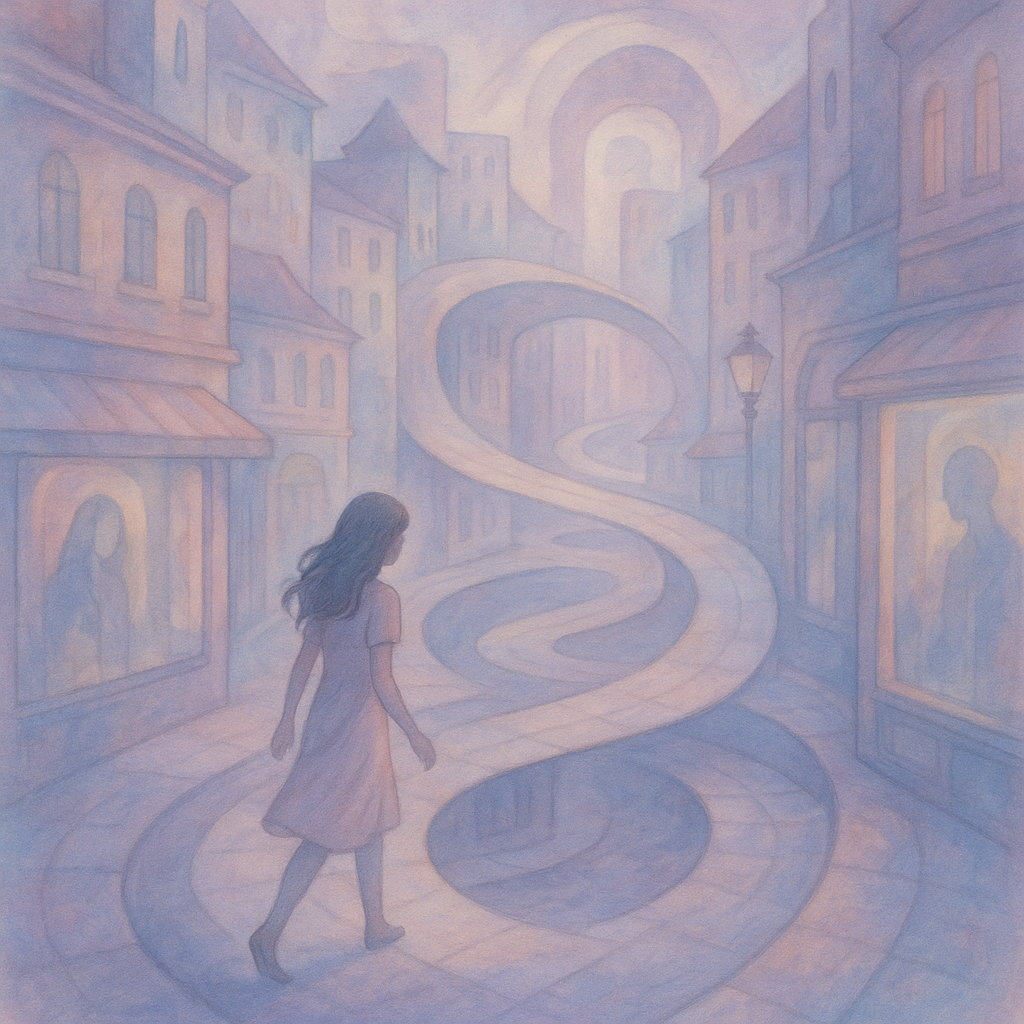
Your Dream
I’m walking through a city that almost feels like home, but every time I turn a corner, the street slides away from me. Sidewalks loop back on themselves, and glossy shop windows reflect unfamiliar faces. I try to read the street signs—one says “Mulberry” until I blink, then it turns to “Halcyon,” the letters rearranging themselves with an oily shimmer. The air is damp, heavy with the scent of rain on hot pavement, and I can hear a distant radio playing something soft and crackly, like the old one I keep in my kitchen for background noise while I cook. I keep checking my pockets for my phone, but my hands come up empty. I know I’m supposed to be meeting someone—maybe my sister?—but my memory slips away when I focus on it. My feet ache the way they do after a long day, and I catch myself worrying absently about my bus pass—which I never even use anymore, but I still can’t seem to throw out.
Your Dream, Revealed
A calm, guided space to explore what this dream may be reflecting back to you.
Dream Overview
This dream unfolds in a city that is nearly familiar, yet persistently elusive, echoing a subtle tension between belonging and estrangement. The emotional tone is a blend of longing, frustration, and gentle nostalgia, heightened by the shifting cityscape that never quite allows the dreamer to arrive. At the heart of the dream is the motif of pursuit—walking towards connection or home, only to have certainty slip away with each turn. Key symbols like the transforming street signs, empty pockets, and looping sidewalks evoke a struggle to find stable ground amid change. There is an undercurrent of anxiety tied to forgetting, losing, and searching for something essential, mirrored in the missing phone and the forgotten meeting. The ache in the feet and the persistent worry about an obsolete bus pass suggest the burden of old habits and unfinished transitions. What makes this dream distinctive is its intricate layering of sensory memory, shifting reality, and the dreamer's gentle but persistent self-questioning, all experienced through a distinctly personal and cultural lens.
The dream begins with a tentative sense of familiarity as the dreamer navigates a city that almost mirrors home, but the atmosphere quickly shifts to unease as the streets defy logic, looping and slipping away. This initial phase is marked by confusion and a repetitive cycle, the dreamer’s movement thwarted by the city’s refusal to allow direct passage. The discovery of the shifting street signs marks a second phase, where reality becomes more unstable, and symbols of orientation and identity dissolve when scrutinized. The third phase emerges as the dreamer checks for their phone, memory faltering about whom they are to meet—this moment crystallizes the tension between the desire for connection and an inability to achieve it. Finally, the narrative settles into a low, persistent worry—aching feet and a preoccupation with a useless bus pass—suggesting resignation and the heavy residue of past patterns.
Key Findings
• The city resembles home yet remains unfamiliar, revealing a split between comfort and alienation. • Shifting street signs ('Mulberry' to 'Halcyon') point to instability in identity or purpose. • Empty pockets and the missing phone highlight a feeling of unpreparedness and loss of connection. • The dreamer's concern for a rarely-used bus pass signals an attachment to outdated routines. • Unfamiliar reflections and elusive meeting details underscore a struggle with memory and recognition.
Symbol Interpretation
City streets
A personal quest for belonging, complicated by shifting circumstances.
Transforming street signs
A struggle to pin down direction or identity amid constant change.
Glossy shop windows
A sense of alienation and uncertainty about self or community.
Empty pockets/missing phone
Feeling unprepared, disconnected, or unable to reach out for support.
Old bus pass
Difficulty letting go of past habits or roles no longer needed.
Distant radio
A longing for comfort, routine, and the familiar solace of home.
Emotional Landscape
At the core of the dream is a quietly mounting anxiety, visible in the dreamer's repeated attempts to orient themselves and reach someone important. This anxiety is made more poignant by the sensation of absence—the missing phone, the elusive meeting, and the unfamiliar faces in the shop windows all evoke a sense of searching for connection where none is easily found. Alongside worry is a thread of nostalgia, highlighted by the distant radio and the sensory memory of rain on pavement, which offer moments of comfort and grounding even as the world shifts. The ache in the dreamer's feet and the concern for the bus pass surface a deeper emotional fatigue, reflecting weariness with old routines and the cost of not letting go. Underneath all of this is a subtle loneliness, not raw or dramatic, but persistent and quietly unsettling, as if the dreamer is gently haunted by the things that once anchored them.
Psychological Insight
The dream maps a psychological landscape of transition—caught between old patterns and uncertain new roles, the dreamer navigates familiar spaces that have become unreliable. The persistent checking for a missing phone and the inability to recall whom they are meeting suggest a desire for connection, yet also an avoidance of confronting what has been lost or changed. The shifting street signs and looping sidewalks mirror an internal struggle with identity and purpose; the dreamer wants clarity and direction but finds only ambiguity. The attachment to the unused bus pass, despite its obsolescence, hints at a reluctance to fully release outdated self-concepts or routines, even as they cause discomfort. Most confronting is the realization that the dreamer’s efforts to orient, connect, and belong are subtly undermined by their own resistance to change—an insight that stirs both compassion and challenge.
Spiritual Perspective
From a Hindu perspective, the city’s shifting nature can be seen as a reflection of maya—the illusion and transience of worldly experience. The dream’s play between familiarity and unfamiliarity, presence and absence, resonates with the spiritual teaching that identity and home are fluid, not fixed in the outer world. The dreamer’s attachment to old objects (the bus pass, the radio’s comfort) echoes the Hindu emphasis on the difficulty of relinquishing attachment, even when it no longer serves the soul’s progress. The rain-washed air and looping paths may evoke the cyclical nature of samsara, where liberation involves recognizing the futility of endlessly retracing familiar steps.
Integrative Insight
This dream weaves together threads of longing, uncertainty, and the subtle ache of transition, revealing a heart caught between the comfort of the past and the necessity of moving forward. It suggests that the dreamer’s search for orientation and connection is hindered less by external confusion than by an inner hesitance to release what is no longer needed. The interplay of familiar comforts (the radio, the bus pass) with elusive destinations (the meeting, the morphing city) makes clear that finding one’s way requires both honoring memory and embracing uncertainty. The dream’s most confronting message is that the ache of holding on can outweigh the fear of letting go. In the end, the city’s shifting paths whisper: only by allowing some things to fade can new directions emerge.
Reflection Questions
- What does the act of searching for your phone—an object of connection—mean to you in the context of feeling lost or disconnected in waking life?
- How do the shifting street signs and looping sidewalks mirror places in your life where you feel directionless or unable to commit to a new path?
- What might you be holding onto (like the bus pass) that once served you but now simply adds weight to your journey?