A dream of the staircase that loops, seen from a Spiritual view
Perspective: spiritual
Your Dream
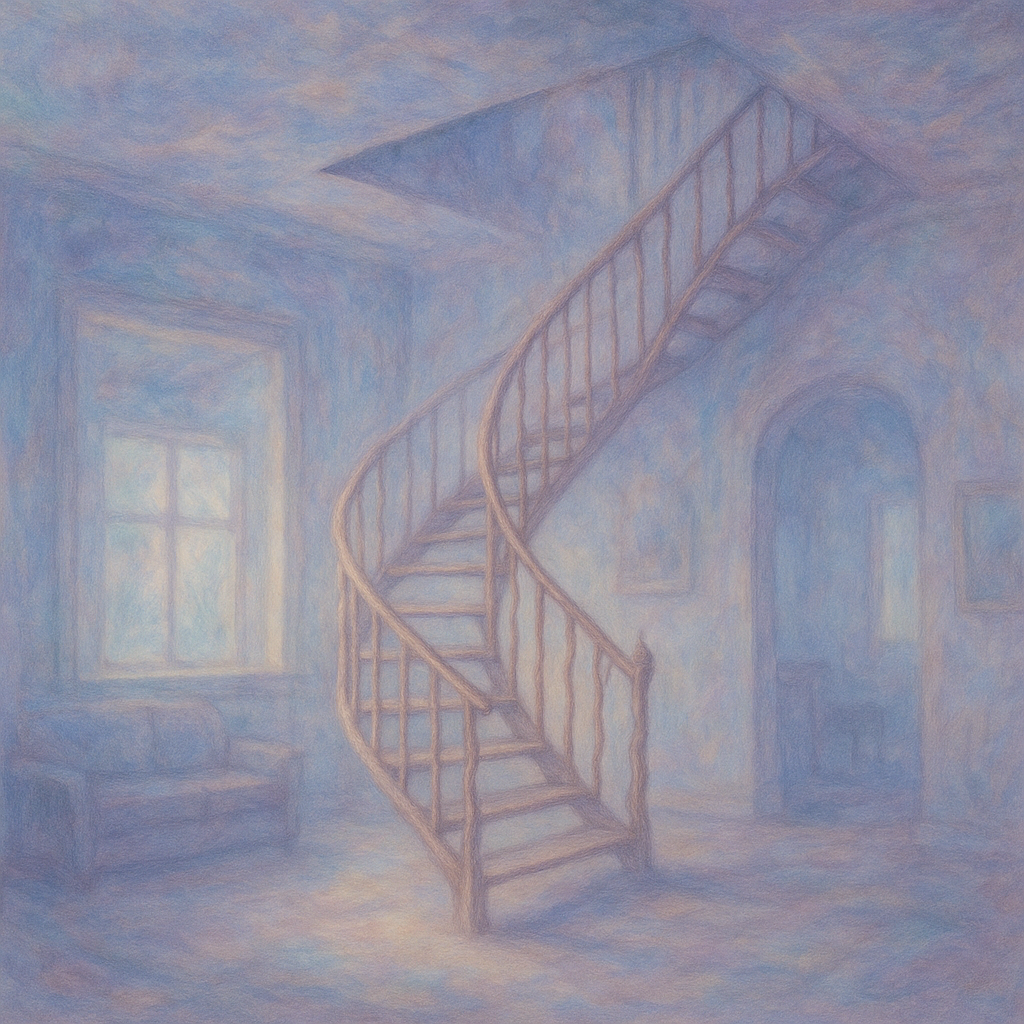
I’m in my childhood home, but it’s rearranged—almost like seeing your neighborhood in a mirror. There’s a staircase in the center of the living room, one I know didn’t exist before, with spindly wooden banisters smoothed over by time. I start climbing, half-expecting to find my old bedroom at the top, but after just a few turns, I’m back where I started by the dusty lamp Mom used to leave on for me. For a moment, I’m convinced I took a wrong step or missed a door. I can smell coffee, strong and a little burnt, and realize I’m still holding the chipped mug I left on my nightstand yesterday. I try the stairs again, slower this time. My socks slide a bit on the wood—too smooth, almost slippery. Each flight curves gently, always left, and the décor shifts with each loop: family photos appear and disappear, sometimes showing people I don’t recognize. There’s a faint hum, maybe the refrigerator or something deeper, like a distant train. Eventually, I sit on a stair, fingers worrying a frayed bit of carpet. A faint draft stirs, carrying the smell of laundry detergent. I’m not scared, exactly, but there’s a sense I’ll never quite reach the top, no matter how many times I try.
Your Dream, Revealed
A calm, guided space to explore what this dream may be reflecting back to you.
Dream Overview
This dream unfolds in the altered space of your childhood home, where familiar foundations are reimagined with unsettling precision. The emotional climate is dense with nostalgia edged by disorientation, as recognizable comforts—like the dusty lamp and the smell of burnt coffee—anchor you even while the world shifts around you. The central tension lies in the looping staircase, a structure that both invites ascent and quietly denies progress, reflecting an intimate struggle with returning to origins while seeking change. Key symbols, such as the chipped mug and vanishing family photos, carry the weight of memory and the uncertainty of belonging. The inner conflict pulses between longing for arrival—finding your old bedroom—and the subtle resignation to perpetual return, never quite reaching higher ground. The recurring sensory details, like the slippery wood and the draft of laundry detergent, underscore a persistent awareness of both comfort and subtle instability. This dream is distinctive for its fusion of the mundane and the surreal, blending everyday objects with impossible architecture to mirror your search for meaning within the shifting boundaries of your own history. What stands out most is the feeling that home is both a sanctuary and a labyrinth, always familiar yet never fully accessible.
The dream opens with a jarring realization: the childhood home is both known and unknown, a mirrored echo of memory. This initial phase introduces the staircase, an anomaly in the living room, setting a tone of curiosity and subtle unease. As you climb, anticipation builds around rediscovering your old bedroom, but the narrative quickly subverts this expectation by looping you back to the starting point, emphasizing frustration and repetition.
The next phase slows the pace; your attempt to ascend becomes more deliberate, revealing your careful negotiation with the unfamiliar. The décor’s shifting—especially the family photos—introduces a dynamic of instability, where even memories cannot be relied upon to remain consistent. The hum and the draft deepen the sense of an underlying current, both comforting and unsettling, that accompanies your journey.
Finally, you choose to stop climbing and sit on the stairs, physically engaging with the environment by worrying a frayed bit of carpet. This marks a turning point from seeking progress to accepting a moment of stillness, even if tinged with resignation. The realization that the top may be unreachable does not evoke fear, but a quiet sadness and acceptance, reframing the dream’s journey as an ongoing process rather than a race to completion.
Key Findings
• The mirrored, rearranged childhood home signals a confrontation with past experiences that feel familiar yet fundamentally altered. • The staircase’s endless looping and leftward curves expose a sense of striving for closure or return that remains just out of reach. • The chipped mug, carried throughout, connects waking reality with the dream’s journey, suggesting unresolved attachments. • The shifting family photos, including unfamiliar faces, highlight questions around identity and belonging within your personal history. • The persistent sensory cues—the hum, the draft, the smell of burnt coffee—reflect a heightened awareness of the intangible but enduring aspects of home.
Symbol Interpretation
Staircase
The staircase is a deeply personal symbol of effort and cyclical striving, embodying the longing to revisit or rise above formative experiences without ever quite escaping their gravity.
Chipped Mug
The mug represents a tangible, imperfect link between your current life and your memories, a vessel for emotions or routines you’re reluctant to let go of.
Shifting Family Photos
These photos evoke questions about identity, lineage, and the evolving nature of family, highlighting both connection and estrangement.
Dusty Lamp
The lamp is a quiet beacon of care and safety from your childhood, now tinged with the dust of time and change.
Sensory Details (Burnt Coffee, Hum, Draft, Detergent)
These layered sensations evoke an intimate, almost haunting familiarity, keeping you tethered to the emotional texture of home even as the environment morphs.
Emotional Landscape
The dominant emotional tone is a complex nostalgia, layered with longing and a subtle sense of loss. Being in your childhood home, even rearranged, evokes a yearning for the comfort and certainty of the past, yet the alterations inject a persistent undercurrent of discomfort. The staircase’s endless loop introduces frustration and self-doubt, especially when you wonder if you ‘missed a door,’ suggesting anxiety about overlooked opportunities or unchosen paths.
The chipped mug in your hand, a relic from waking life, brings a gentle pang of regret or unfinished business, as if something important remains unresolved or unspoken. The shifting family photos, especially the appearance of unfamiliar faces, stir a quiet unease about your place within your own story, hinting at questions of belonging and the passage of time.
Despite these currents, there is a notable absence of outright fear. Instead, a contemplative melancholy prevails, culminating in your decision to sit and simply notice the draft and the texture of the carpet. This emotional pause, marked by neither defeat nor triumph, suggests a willingness to inhabit uncertainty—a brave acknowledgment that some journeys are measured not by arrival, but by presence in the moment.
Psychological Insight
The dream reveals a powerful drive to reconnect with formative experiences, yet this desire is complicated by the realization that those experiences—and your relationship to them—are fundamentally altered. The act of climbing the staircase, expecting to find your old bedroom, reflects a hope for rediscovery or restoration of something lost, but the looping structure forces repeated confrontation with the impossibility of full return.
The chipped mug serves as a psychological anchor, indicating an unresolved attachment to present realities or routines that persist even in the midst of deep reflection. The anxiety about missing a door or taking a wrong step exposes a fear of having overlooked crucial choices, and perhaps a subtle self-critique about the direction of your life’s journey.
The shifting photos and décor reveal an internal struggle with identity—how your sense of self is influenced by both recognized and unknown elements of your past. By ultimately choosing to sit and notice, rather than continue climbing, you demonstrate a capacity for acceptance and introspection, even as you grapple with the limitations of what can be reclaimed or changed.
Spiritual Perspective
The dream’s setting and symbolism resonate with a spiritual search for meaning within the structure of your own history. The looping staircase and mirrored home evoke spiritual motifs of cycles, return, and the elusive quest for wholeness, suggesting that your journey is less about linear progress than about embracing the ongoing process of self-discovery.
The objects and sensory details—especially those that connect directly to memory and care—hint at a deeper longing for spiritual grounding amidst life’s transformations. Sitting on the stairs, rather than pushing relentlessly upward, can be seen as an act of spiritual presence: choosing to be with what is, even when it isn’t what you expected or hoped for.
Integrative Insight
Your dream weaves together the ache of nostalgia with the restless search for progress, revealing that home is not a fixed place or a destination, but a shifting landscape shaped by your willingness to revisit, question, and accept. The looping staircase and mutable décor demonstrate that the past can never be fully reclaimed, yet its echoes remain powerfully alive in your senses and your choices. By pausing to notice the details—frayed carpet, passing scents, the lamp’s glow—you find meaning in presence rather than arrival.
The most memorable realization here is that sometimes the journey itself, with all its loops and imperfections, is the only home you truly need to understand.
Reflection Questions
- When you found yourself looping back to the dusty lamp, what memories or feelings about safety and care surfaced most strongly?
- How do you relate to the chipped mug you carried throughout the dream—what current routines or attachments in your waking life feel equally worn but necessary?
- What emotions arose as you noticed unfamiliar faces in the family photos, and how might these connect to your current questions about identity or belonging?