A dream of the quiet hospital corridor, seen from a Hindu view
Perspective: hindu
Your Dream
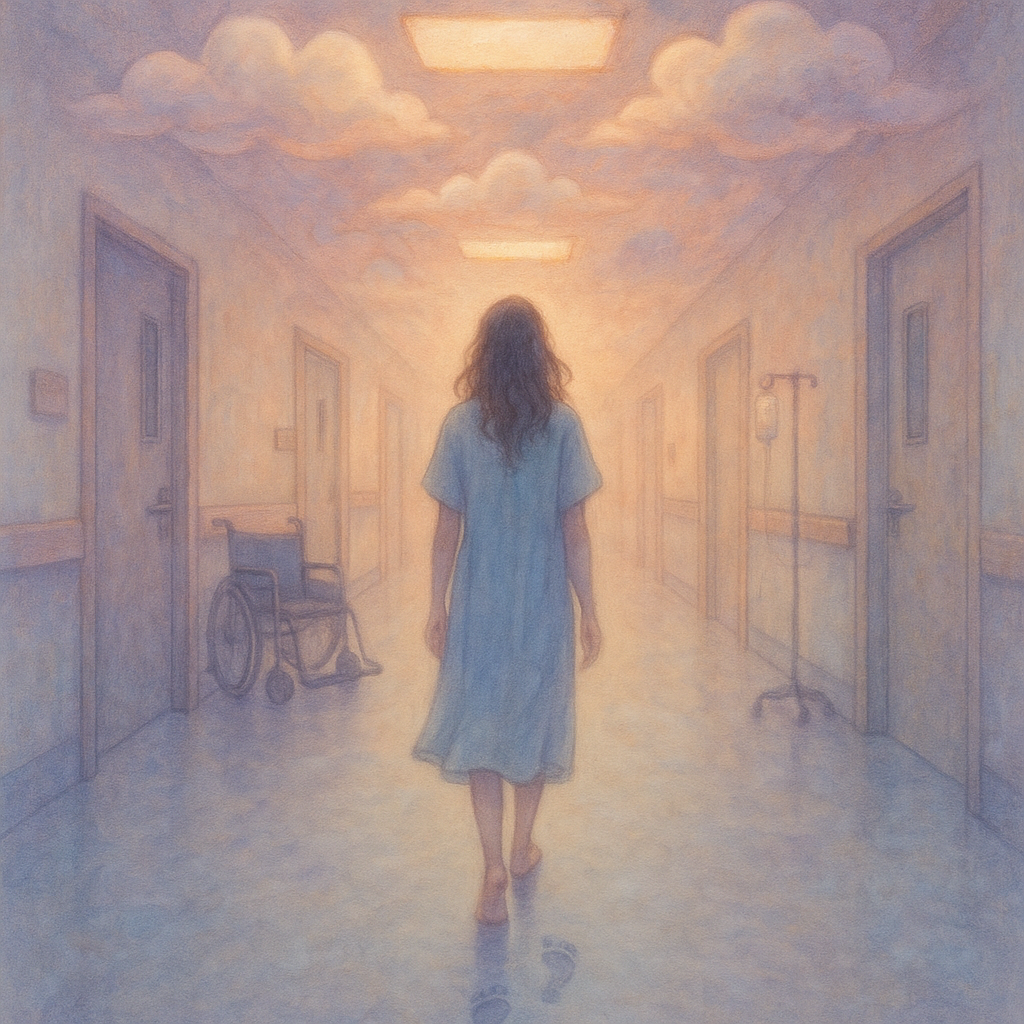
I'm walking barefoot down a quiet hospital corridor, my steps muffled by the gray linoleum. The lights overhead hum softly, not exactly bright but more like a permanent late afternoon, that kind of dimness that makes everything look a little colorless. I can smell just a trace of antiseptic, sharp and strangely sweet, mixed with the scent of laundry—like the sheets Mum used to hang out, only stronger. My hospital gown keeps slipping off one shoulder, and for a moment I try to shrug it back up, but my arm moves sluggishly, as though I’m pushing through water. There’s a clipboard hanging crookedly on the wall outside each room, some with messy handwriting, others oddly blank. I pause at one, squinting to make out a name, but the letters keep rearranging themselves, blurring into nonsense. I get a quick, irrational worry—did I forget an appointment? Is someone waiting for me? But then that thought slides away and I’m just aware of the silence again, the way sound is swallowed up here. No voices, no beeping machines, not even the distant rattle of a gurney; just my breathing and that low electric hum. I realize I’m carrying my phone, even though I don’t remember picking it up. The screen is cracked, a tiny spiderweb in the corner (I should really get that fixed). When I try to unlock it, my thumb won’t line up properly and the numbers melt under my fingers. A cleaning cart appears at the far end of the hall, unattended, a single blue glove left on the handle. I think about putting it away, being helpful, but the corridor seems impossibly long, and the further I look, the less real it seems—like the end of the hallway has been erased by an eraser pressed too hard. I just stand there, holding my useless phone, feeling like I’m waiting for someone to come and tell me where I’m supposed to go.
Your Dream, Revealed
A calm, guided space to explore what this dream may be reflecting back to you.
Dream Overview
This dream unfolds in a liminal hospital corridor, where the air is thick with a blend of clinical sterility and deeply personal memory—the sharp-sweet antiseptic mingling with childhood laundry. The emotional atmosphere is muted yet tense, with the dreamer moving barefoot across gray linoleum, exposed and slowed by an uncooperative body. Central tension emerges in the dreamer's struggle to find clarity or purpose, symbolized by unreadable clipboards and a phone that resists unlocking—tools meant to guide or connect, now rendered useless. A subtle anxiety flickers in the worry about a missed appointment, quickly dissolving into pervasive uncertainty and silence. The dream's unique quality lies in its resistance to resolution: even the urge to help (the abandoned cleaning cart and glove) is paralyzed by distance and unreality. The interplay between familiar comfort (the scent of laundry, memory of Mum) and institutional detachment creates a sense of suspended belonging. What stands out most is the dreamer’s quiet, almost resigned waiting—for instruction, reassurance, or permission to move—caught between old roles and new uncertainties.
The dream begins with a slow, muted entry—barefoot steps on gray linoleum, lights casting a perpetual twilight, and a vivid sensory impression of antiseptic and laundry. The early phase is marked by bodily awkwardness: the slipping gown and heavy arm, instilling a sense of struggle against one's own sluggishness. Midway, the dreamer’s attention shifts outward to the environment: the enigmatic clipboards, the irrational worry about missing an appointment, and the oppressive silence. This is a moment of seeking—trying to decode information, to remember one’s purpose, only for clarity to dissolve. The final movement is marked by objects just out of reach: the cracked phone that won't unlock, the distant cleaning cart and glove, and the corridor fading into unreality. The dream closes not with decision or escape but with stasis and anticipation, the dreamer waiting for guidance in a world that offers none. Each phase deepens a sense of suspended action and uncertain identity.
Key Findings
• The barefoot walk highlights a sense of exposure and vulnerability in a setting that is usually formal and protected. • Unreadable clipboards and melting phone numbers underscore a struggle to access information or guidance, linking to doubt about personal direction. • The hospital gown slipping and sluggish movements evoke frustration with self-expression or agency. • The unattended cleaning cart and single glove suggest a pull toward helpfulness or responsibility, yet also an awareness of futility. • The blending of antiseptic and laundry scents reveals a tension between institutional sterility and intimate, familial comfort.
Symbol Interpretation
Bare feet
A feeling of being unguarded and possibly unprepared, exposed to unfamiliar or intimidating circumstances.
Hospital corridor
A transitional space where the dreamer feels neither here nor there, mirroring a state of limbo or waiting in life.
Unreadable clipboards
Difficulty in making sense of responsibilities, expectations, or messages—an ongoing search for clarity that remains elusive.
Cracked phone
A desire for connection or control that is impeded by fragility and malfunction, suggesting frustration with communication or access.
Cleaning cart and blue glove
A call to duty or helpfulness that feels distant and possibly unreachable—reflecting on responsibility that cannot be fulfilled in this state.
Scent of antiseptic and laundry
A poignant mixture of institutional care and personal history, evoking nostalgia and longing for comfort amid coldness.
Emotional Landscape
The dream’s emotional texture is quiet but charged, like the hum of the lights overhead—an undercurrent of anxiety that never erupts into panic. The dreamer’s bodily vulnerability (bare feet, slipping gown, sluggish arm) evokes a private frustration, a longing to feel more presentable or capable. When the clipboards refuse to yield information and the phone becomes unusable, a sharper worry flickers: the fear of missing out or letting someone down, quickly replaced by resignation as the silence reasserts itself. The urge to help—to put away the cleaning cart, to do something useful—emerges as a brief hope, but is swallowed by the sense of futility and distance. The emotional core is a blend of exposed waiting and gentle nostalgia, the memory of Mum’s laundry offering brief warmth in an otherwise impersonal space.
Psychological Insight
The dream reveals a psyche caught between wanting to act and feeling unable to do so. The unreadable clipboards and malfunctioning phone suggest a desire for direction, structure, or reassurance, but also an internalized belief that these will not be accessible. The sluggish arm and slipping gown point to self-doubt or shame about feeling unable to perform as expected—whether in practical life or in emotional expression. The dreamer’s inclination to be helpful is genuine, but the impossibly long corridor and fading reality illustrate a sense of being separated from concrete action, perhaps by self-imposed hesitation or external uncertainty. The gentle confrontation here is the pattern of waiting for permission or external instruction rather than claiming one’s own authority—an avoidance of self-definition hidden within the comfort of passivity.
Spiritual Perspective
Within a Hindu spiritual framework, the dream's corridor could be seen as a metaphorical crossing—a samsara, or passage between states, where the soul lingers before moving forward. The blending of antiseptic (purification) and laundry (familial memory) resonates with the tension between the material and the ancestral, both of which are honored in Hindu tradition. The dream’s stasis, the sense of waiting for instruction, may reflect an unconscious deference to dharma—waiting for one's role or duty to be clarified by external signs. Yet the absence of voices, guides, or rituals in this dream questions whether the dreamer is relying too much on tradition or external validation, and not enough on inner clarity or self-guidance.
Integrative Insight
Taken together, the dream captures a deeply personal moment of suspension: the dreamer is aware of the need to step forward but feels unprepared, unsupported, and unclear about the correct direction. The longing for comfort and guidance is palpable, yet every tool—be it clipboard, phone, or the possibility of action—remains out of sync or out of reach. The hospital corridor stands as both a place of healing and a place of waiting, amplifying the dreamer’s internal impasse between the familiar past and an uncertain future. What the dream ultimately illuminates is the subtle cost of waiting for external validation: the sensation of standing still, shoes off, in a world that is half real and half memory. In the silent corridor of this dream, the most radical act may be to choose a direction before anyone tells you where to go.
Reflection Questions
- When in waking life do you feel exposed or unprepared, as you did walking barefoot with your gown slipping in the dream?
- What personal responsibilities or decisions currently feel as illegible or slippery as the rearranging names on the clipboards?
- If you stopped waiting for instruction, what action—however small—would you take in your own 'hospital corridor' right now?