A dream of the city with shifting streets, seen from a Islamic view
Perspective: islamic
Your Dream
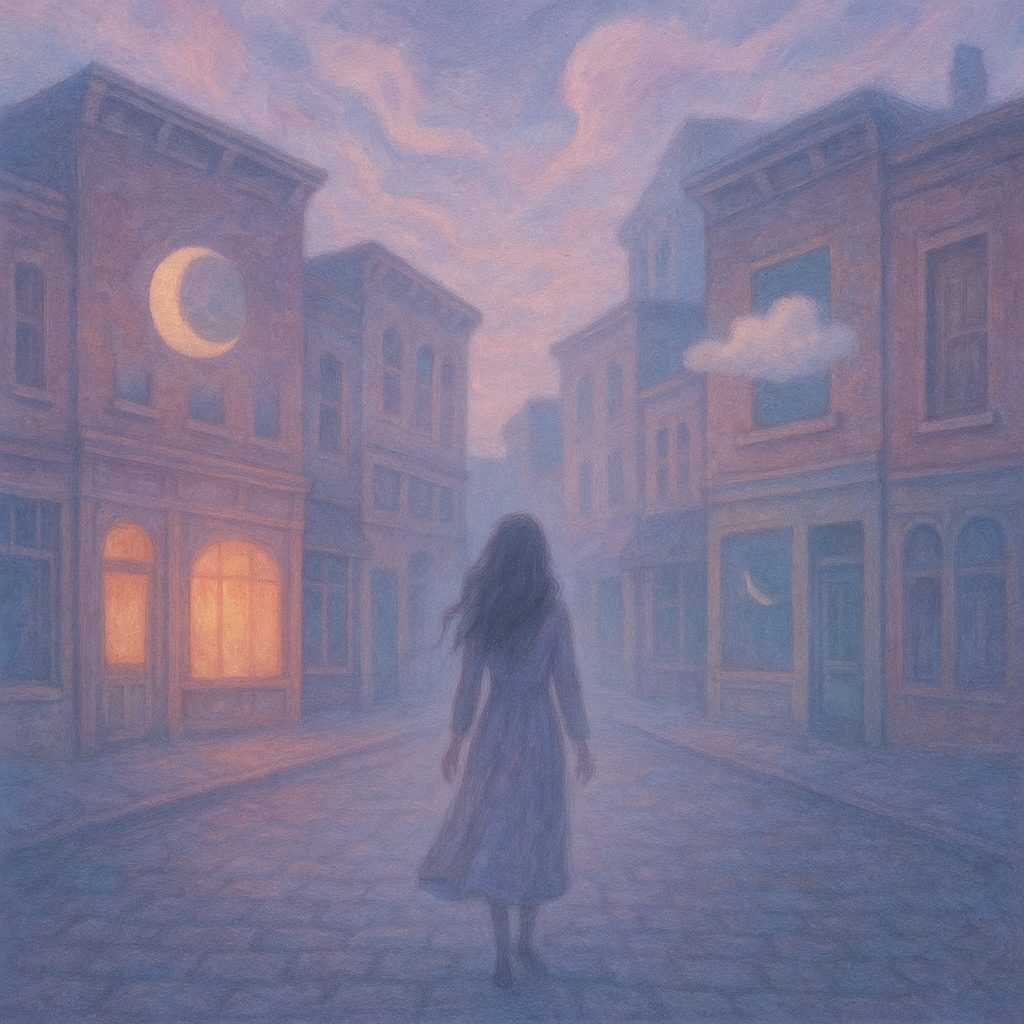
Last night, I dreamt I was wandering through a city that couldn’t make up its mind. The buildings looked familiar—old brick storefronts like the ones on Main, except there was always one detail off, like a neon sign in a language I couldn’t understand or doors a little too small. I was supposed to meet someone, maybe my brother or that friend from college I haven’t thought about in ages, but every time I turned a corner the street would bend in a new direction, just slightly wrong. At one point I tried to retrace my steps, counting the cracks in the sidewalk, but the next time I looked down the cracks were zigzags, not straight lines. I passed a bakery that smelled like cinnamon, and I thought for a second about stopping—my stomach was rumbling, which is weird because I’d literally just had toast for dinner in real life. Inside, a woman behind the counter was talking on the phone, but her voice echoed too much and the words were all mixed up. I tried to ask her for directions, but she just shook her head and pointed out the window, where the street outside was slowly sliding to the left, like a rug being pulled away. I felt anxious, but also weirdly fascinated, like I almost wanted to see what would happen if I just followed wherever the city wanted me to go.
Your Dream, Revealed
A calm, guided space to explore what this dream may be reflecting back to you.
Dream Overview
This dream unfolds in a cityscape that stubbornly resists coherence, offering a familiar foundation but distorting it with unsettling details—like neon signs in unreadable scripts and shrunken doors. The emotional tone is marked by a sense of anxious curiosity, heightened by the persistent search for someone whose identity blurs between past and present relationships. The central tension arises from the dreamer's attempt to orient themselves in an environment that subtly undermines every effort at control, as seen in the shifting streets and unreliable landmarks. Key symbols, such as the bakery with its inviting scent and the woman behind the counter whose words dissolve into echoes, embody both comfort and confusion. The dream's inner conflict revolves around the urge to find stability versus a strange allure toward following the unpredictable flow of the city. What makes this dream distinctive is the way ordinary details—like cracks in a sidewalk or the smell of cinnamon—are warped just enough to challenge trust in perception and memory. The dreamer’s experience is not simply one of being lost, but of navigating a world that playfully resists clarity, inviting both apprehension and wonder. This quality of almost-recognition, paired with gentle frustration, suggests a unique tension between nostalgia and transformation.
The dream begins with a gentle disorientation: the city feels almost like home but immediately unsettles with details that are slightly off. This initial phase sets a tone of cautious curiosity, as the dreamer wanders, searching for someone whose identity itself is ambiguous—a blend of family and distant friendship. As the city’s streets bend and shift, the narrative tension intensifies; every attempt to gain direction or retrace steps is thwarted by subtle transformations, such as the cracks in the sidewalk turning to zigzags.
The encounter at the bakery marks a pivot: the sensory comfort of cinnamon is juxtaposed by the confusion of the woman's echoing, indecipherable words. This moment crystallizes the dream’s central dilemma—yearning for clarity and guidance, but finding only vague gestures and shifting ground. The city’s final act, with the street sliding away, propels the dreamer into a state of both anxiety and fascination, caught between the urge to regain control and the temptation to surrender to the unknown direction.
Throughout, the dreamer oscillates between attempts to impose order and a growing, almost reluctant acceptance of the city’s autonomy. The narrative’s phases—wandering, searching, seeking help, and finally considering surrender—trace a journey from resistance to tentative openness, each stage marked by specific, surreal disruptions that transform ordinary actions into enigmatic challenges.
Key Findings
• The city's familiar-yet-wrong architecture highlights a struggle to reconcile memory with current reality. • The shifting street directions expose the dreamer's sense of losing control when searching for connection. • The bakery’s comforting scent contrasts sharply with the garbled communication, underscoring the longing for clarity and guidance. • The act of counting cracks, only to find them changed, reflects an urge for reliability that remains out of reach. • The final choice to follow the sliding street hints at a subtle willingness to embrace uncertainty, despite anxiety.
Symbol Interpretation
Distorted City
Represents the dreamer's experience of their daily world feeling subtly unreliable or estranged, possibly linked to recent changes or unresolved questions.
Unknown Language/Neon Signs
Reflects feelings of exclusion or difficulty understanding an important message or social cue in waking life.
Shifting Streets
Embodies the instability of plans or personal goals, where progress is continually redirected or undermined.
Bakery and Cinnamon Scent
Symbolizes a longing for comfort or reassurance, perhaps tied to deeper emotional needs not satisfied by routine actions.
Woman Behind the Counter
Represents an authority or guide who cannot provide clear answers, mirroring ways in which support feels distant or distorted.
Cracks in the Sidewalk
Reflects a desire for predictable markers in life, undermined by the unpredictable nature of the dream environment.
Emotional Landscape
The dream opens with a subtle anxiety rooted in the city’s refusal to cooperate, as familiar elements are rendered unreliable. This unease is not overwhelming, but persistent, manifesting in the dreamer’s repeated attempts to orient themselves and find someone important.
A deeper layer of frustration emerges when efforts to retrace steps are undermined by changing details, such as the cracks in the sidewalk that refuse to stay straight. This frustration is not just about being lost, but about the rules of the world shifting just out of reach, leading to a private sense of helplessness.
The bakery episode introduces a brief, almost hopeful yearning for comfort—a momentary desire to pause and satisfy a need, even as the dreamer is aware that their hunger is not literal. The disappointment of the woman’s non-response intensifies a feeling of isolation, as the possibility of connection collapses into confusion and ambiguity.
Yet, woven throughout is a thread of fascination: in the face of persistent uncertainty, the dreamer finds themselves drawn to the unfolding strangeness, curious about what lies beyond the next distortion. This mix of anxiety and intrigue gives the dream its unique emotional texture, suggesting a complex relationship with change and unpredictability.
Psychological Insight
At the heart of the dream lies a deep-seated desire for both orientation and connection—evident in the search for someone who is never quite located, and the repeated attempts to make sense of the city’s logic. This suggests the dreamer may be grappling with transitions or decisions in waking life that feel both familiar and strangely altered, as if the ground rules have shifted without warning.
The shifting street directions and mutable landmarks point to a reluctance to accept instability; the dreamer’s instinct is to seek patterns, count cracks, and retrace steps, even as these efforts are subtly undermined. This hints at a resistance to letting go of control, possibly fueled by recent experiences where usual strategies for problem-solving have failed.
The bakery sequence, with its sensory pull and disappointing outcome, reflects a longing for reassurance and guidance, met with confusion instead of clarity. The inability of the woman to provide directions may mirror a sense of not being heard or understood in real life, or of authorities and helpers being unavailable or unhelpful when needed.
The final acceptance—the strange pull to follow the city’s sliding direction—suggests a psychological negotiation between the fear of uncertainty and the allure of new possibilities. The dreamer is not simply trapped; they are also, perhaps, practicing a cautious openness to paths that cannot be fully anticipated.
Spiritual Perspective
Within an Islamic context, the dream’s city—familiar yet subtly distorted—could be interpreted as reflecting the tension between dunya (the material world) and the search for spiritual clarity. The repeated frustration and longing for direction may echo the Qur’anic motif of guidance and misguidance: the dreamer’s attempts to find their way are met with shifting signs, much like the challenges of interpreting life’s tests.
The bakery’s aroma and the act of seeking directions can be seen as expressions of fitrah—a natural desire for comfort, sustenance, and right path. Yet, the inability to receive clear help from the woman behind the counter may resonate with the spiritual experience of du’a (supplication) that feels unanswered, prompting the believer to reflect on patience, trust, and the wisdom of unseen outcomes.
Ultimately, the dream’s pull toward following the unpredictable city hints at a gentle invitation to tawakkul—placing trust in Allah when certainty is elusive, and accepting that some answers are not immediately accessible by effort alone.
Integrative Insight
This dream weaves together the familiar and the uncanny, revealing how even well-known environments can become sources of anxiety when subtle distortions undermine trust. The emotional journey from seeking clarity to considering surrender reflects a real-life negotiation between holding on and letting go, especially when guidance seems absent and the way forward is unclear.
By highlighting cravings for comfort that are never quite fulfilled, and encounters with authority figures who cannot provide direct answers, the dream surfaces a poignant tension: the need to act with intention even when the world refuses to be pinned down. The most memorable realization from this dream is that sometimes, the only way to move forward is to allow uncertainty its place, and to trust in meaning that emerges not from control, but from patient navigation.
Reflection Questions
- What is the first detail in the dream city that made you realize something was off, and how does that mirror moments of subtle dissonance in your waking life?
- When the woman in the bakery could not give you directions, what feeling lingered most—frustration, disappointment, or relief—and when have you experienced a similar response to guidance in real life?
- What draws you to the idea of following the sliding street, despite your anxiety, and how does this reflect your current relationship with uncertainty or change?