A dream of the abandoned classroom, seen from a Other view
Perspective: other
Your Dream
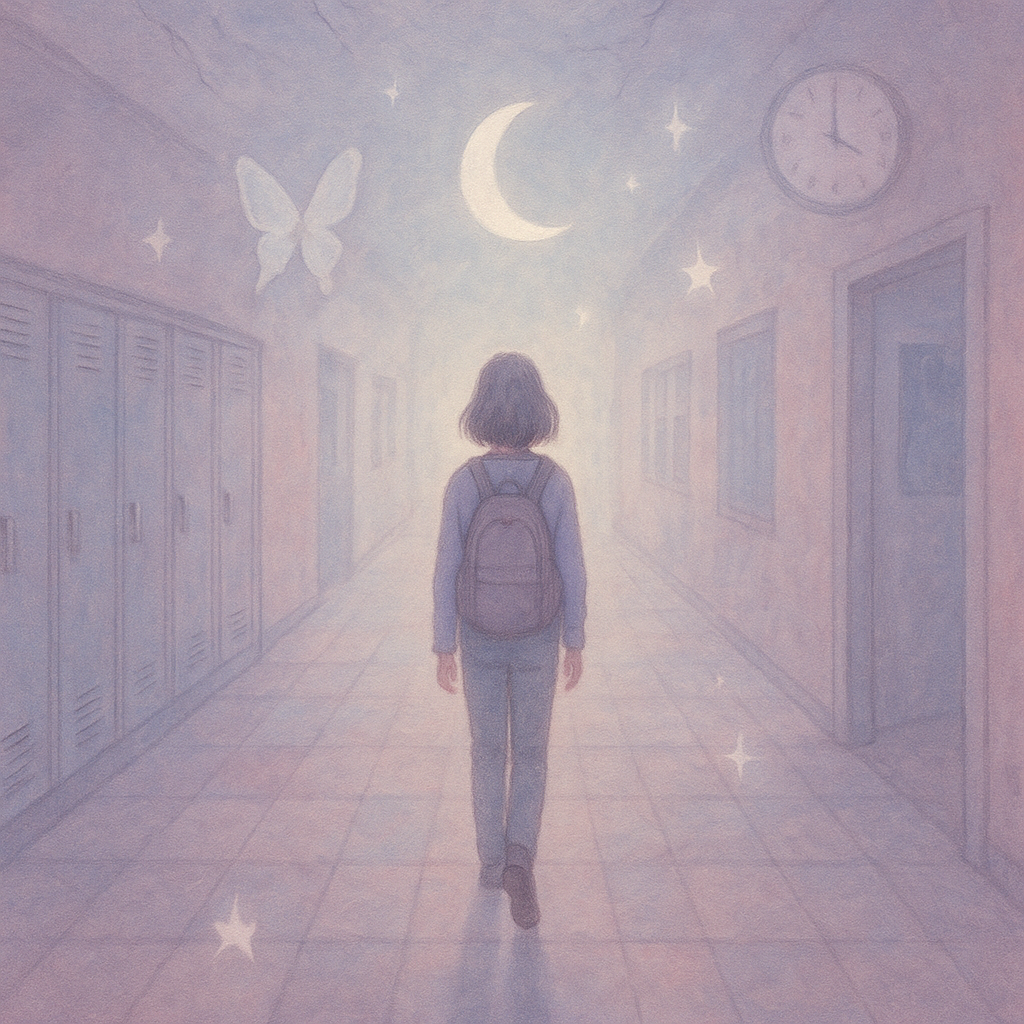
Last night I dreamed I was wandering through my old middle school, but everything felt slightly off, like the colors were more faded than I remembered. The halls echoed with my footsteps, and there was this weird, not-unpleasant smell of old books mixed with dust—sort of like the back room of a thrift store. I was carrying a mug (with that chipped green band my mom always complains about), except there wasn’t any coffee in it. No one else was there, except I kept hearing faint whispers coming from behind doors that wouldn’t open. Eventually, I found myself in a classroom at the end of the hall. The desks were all scattered, some piled up at weird angles, and sunlight struggled through dirty windows, lighting up chalk dust in the air. For some reason I started rearranging the desks into tidy rows, even though I could tell no one was coming back. I tried to write something on the chalkboard, but my hand kept slipping, and the chalk would only make a faint squeak. I remember feeling oddly comforted, like fixing those desks meant things were okay, or would be, even though I know that classroom has been empty for years.
Your Dream, Revealed
A calm, guided space to explore what this dream may be reflecting back to you.
Dream Overview
This dream unfolds in the liminal space of an old middle school, where faded colors and echoing footsteps create a backdrop of subtle disquiet. The emotional tone is a mix of nostalgia, solitude, and a peculiar comfort, heightened by sensory details like the thrift-store scent and the empty mug. The central tension lies between a longing to restore order—seen in the act of arranging desks—and an acceptance that the past cannot be fully revived, as indicated by locked doors and elusive whispers. Key symbols such as the chipped mug, the scattered desks, and the futile chalk gesture all point to attempts at mending or making sense of something that remains just out of reach. The dreamer’s inner conflict surfaces in the comfort found in futile actions, hinting at a desire for control amid powerlessness. What sets this dream apart is its gentle confrontation with absence: the dreamer feels soothed not by success, but by the mere act of trying to restore an abandoned space. This dream is distinctive for how it weaves together sensory memory, quiet persistence, and the ache of unfulfilled communication.
The dream begins with a slow, wandering exploration through the old middle school, establishing a mood of reflective solitude. Every sensory detail—the faded hues, the echoing halls, the thrift-store scent—anchors the dreamer in a familiar yet subtly alien landscape. The encounter with locked doors and whispers marks a shift: curiosity and low-grade unease emerge, as the dreamer is denied access to certain memories or meanings. Entering the classroom at the end of the hall brings a new phase; this is a space of active engagement, however futile, as the dreamer arranges desks into order despite knowing no one will return. The final act—trying and failing to write on the chalkboard—signals resignation, but also a surprising comfort, as if the effort itself, not the outcome, brings peace. The narrative closes with a sense of quiet acceptance, the dreamer soothed by their own small, caring actions in an otherwise empty place.
Key Findings
• The faded colors and thrift-store smell evoke a complex nostalgia tinged with loss. • Carrying a familiar, chipped mug with no coffee suggests grasping for comfort in incomplete or altered forms. • Locked doors and disembodied whispers point to unresolved questions and inaccessible memories. • The act of rearranging empty desks reveals a wish to impose order even when outcomes are futile. • The comfort in repeatedly failing to write on the chalkboard hints at acceptance of limitation and change.
Symbol Interpretation
Chipped Mug
This symbol embodies imperfect comfort—something cherished but flawed, and unable to fulfill its original purpose.
Faded Colors
Faded colors signify memories that have dulled over time, reflecting the erosion of vividness in past experiences.
Echoing Footsteps
This symbol reinforces isolation and self-awareness, marking the dreamer’s presence in a space defined by absence.
Whispers Behind Locked Doors
These whispers represent inaccessible parts of memory or unresolved parts of self, provoking curiosity and a sense of incompletion.
Scattered Desks
Scattered desks signal disorder and past disruption; the attempt to line them up speaks to a need for agency in the face of chaos.
Chalk and Chalkboard
This symbolizes a struggle to communicate or leave a mark, revealing frustration with fleeting or ineffective expression.
Emotional Landscape
Nostalgia is threaded through every moment of this dream, but it is not straightforward longing; it is tinged with the sorrow of knowing that what is gone cannot be reclaimed in its original form. The emptiness of the mug and the echoing halls evoke a subtle grief, a recognition of all that is missing or changed beyond repair. The act of arranging desks, though futile, brings comfort—suggesting that the dreamer finds solace in acts of care, even when they cannot change the fundamental emptiness around them. The persistent but unfulfilled attempt to write on the chalkboard reveals a layer of gentle frustration, softened by the dreamer’s willingness to keep trying in the face of repeated failure. Comfort arises not from resolution, but from the dreamer’s ability to exist with these unresolved feelings, transforming discomfort into a quiet, private reassurance.
Psychological Insight
The dreamer’s wandering is not aimless, but driven by a subtle search for understanding or closure within a familiar, yet altered, environment. Carrying the chipped mug, a flawed item with personal history, suggests a pattern of holding onto imperfect sources of comfort or identity. Locked doors and mysterious whispers highlight a guardedness, a tendency to keep certain thoughts or memories inaccessible, possibly as a form of self-protection. The compulsive rearrangement of desks is an attempt to impose order and meaning on chaos—a coping mechanism that soothes anxiety, even if it cannot restore what was lost. The repeated, unsuccessful effort to write on the chalkboard points to a struggle with self-expression or feeling heard, indicating a deeper wish to leave a mark or communicate effectively, despite internal or external barriers.
Spiritual Perspective
Given the dreamer’s identification with 'other' in terms of spiritual or belief system, there is a sense of standing both inside and outside traditional frameworks of meaning. The dream’s focus on faded memory and futile restoration suggests a worldview that accepts impermanence without resorting to comforting illusions. Instead of searching for signs or messages, the dreamer finds meaning in the act of engagement itself—even when the results are ambiguous or incomplete. This perspective allows the dreamer to value effort and presence rather than final answers or closure, aligning with a belief in the inherent worth of honest striving and quiet acceptance.
Integrative Insight
The dream reveals a gentle resilience: the dreamer persists in acts of care and order even when certainty and connection are out of reach. By tending to the abandoned classroom and embracing the chipped mug, the dreamer honors the imperfect, the faded, and the incomplete—finding comfort not in fixing the past, but in showing up for it, again and again. The locked doors and faint chalk marks remain, but their power is softened by the dreamer’s willingness to engage with emptiness and ambiguity. This is not a dream of resolution, but of quiet courage in the face of loss. Sometimes, the most honest healing is found in arranging the world’s scattered pieces, knowing they may never fit as they once did.
Reflection Questions
- What memories or aspects of yourself feel 'locked behind doors' right now, and what might you be avoiding by not opening them?
- How do you relate to the idea of finding comfort in unfinished or imperfect things, as symbolized by the chipped mug and faded colors?
- In what areas of your current life are you imposing order or care, even when you sense no one else will notice or benefit?