A Christian take on the dream of the quiet hospital corridor
Perspective: christian
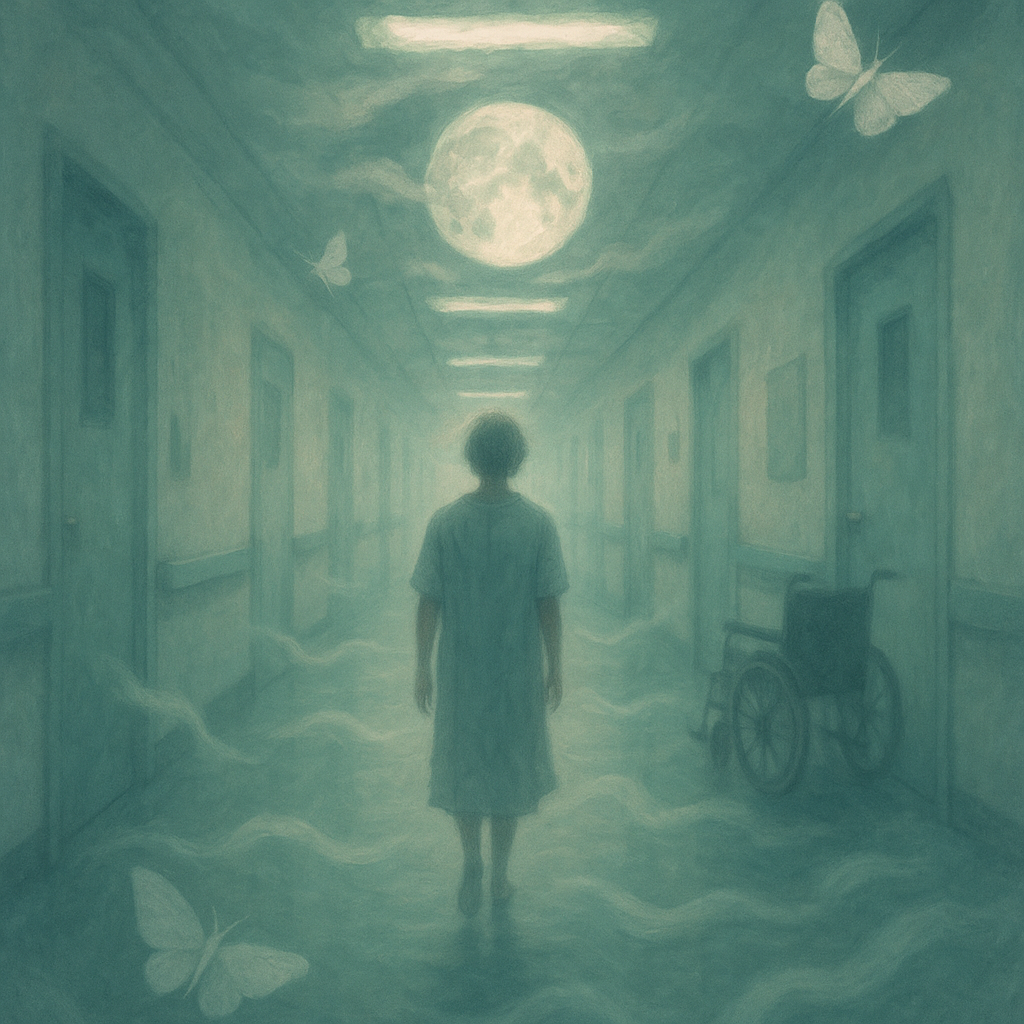
Your Dream
I’m moving down a hospital corridor, the kind with pale green linoleum and flickering fluorescent lights. Everything is hushed, not silent, exactly, but muffled in that way hospitals get late at night, where every footstep—mine included—echoes further than seems possible. I’m vaguely aware I’m barefoot, my toes cold against the strange slick surface, but I don’t slow down. I clutch my phone in one hand, even though the lock screen is smudged with fingerprints and I keep glancing at it as if I’m expecting a message. I know, in the strange logic of dreams, that someone important is in one of these rooms, but I’m not sure who, or why I’m here alone. There’s a faint smell of antiseptic blending with something sweet, maybe a floral air freshener, which somehow makes me uneasy. A nurse’s cart rattles in the distance, vanishing around a corner before I can catch a glimpse of its owner. The corridor stretches ahead, impossibly long, lined with closed doors. I pause by a window; outside, the sky is blue instead of night-dark, which doesn’t make sense, but I accept it. I can see my reflection—hair mussed, T-shirt rumpled, the one I wore yesterday I think, with a faint coffee stain near the hem. I’m almost embarrassed to be wandering here looking this way, but nobody seems to notice or care. I try to open one of the doors, and it’s surprisingly heavy. Behind it, there’s only an empty room with a single bed neatly made, tucked in the way my grandmother used to fuss over hospital corners. The room hums with a soft mechanical whir, maybe a ventilator or just the air conditioning. I stand there for a moment, feeling both the quiet hope that comes from something so ordinary and a sudden, sharp pang of loneliness—like I’ve missed someone by a few minutes, or maybe a few years.
Your Dream, Revealed
A calm, guided space to explore what this dream may be reflecting back to you.
Dream Overview
This dream unfolds in a hospital corridor at night, a place marked by its pale green linoleum, flickering lights, and a muffled hush that amplifies each footstep. The emotional tone is one of quiet urgency mingled with isolation, as the dreamer moves barefoot and alone, clutching a smudged phone as if awaiting a vital message that never arrives. Central tension centers on the unknown presence in one of the rooms and the dreamer’s ambiguous mission—driven yet unmoored, compelled to proceed but never quite knowing why. Key symbols like the hospital corridor, the phone, the window with an impossible blue sky, and the heavy door each layer this journey with meaning that feels suspended between anxiety and hope. Inner conflict surfaces in the dreamer’s embarrassment at their disheveled appearance juxtaposed with a lack of external judgment, highlighting a struggle between self-perception and the indifference of the environment. The sterile-yet-sweet scent and the vanishing nurse’s cart deepen the sense of something vital being just out of reach. What makes this dream distinctive is how it fuses the mundane with the surreal—the blue daytime sky at night, the familiar hospital corners, and the sense of missing someone by a margin that feels both immediate and spanning years—creating an atmosphere both haunting and deeply personal.
The dream opens with the dreamer in motion, propelled by a vague but pressing purpose down a dim, empty corridor. Every footstep echoes in the hush, amplifying the sense of solitude and anticipation; the dreamer’s focus is split between the physical discomfort of bare feet and the emotional urgency of the phone in hand. As the corridor stretches on and the nurse’s cart rattles away, the dream enters a phase of searching without arrival—doors remain closed, support is glimpsed but never grasped. Pausing at the window marks a brief interlude: the blue sky outside offers a stunning, illogical contrast to the night, a momentary respite that is quietly accepted rather than questioned. The narrative culminates in the attempt to open a heavy door and the discovery of the empty, perfectly made bed—a scene that fuses ordinary comfort with acute absence, closing the dream with a sensation of missing someone by a margin that feels simultaneously recent and irrevocably distant. Each stage reflects an evolving interplay between pursuit and inaccessibility, hope and resignation, connection and solitude.
Key Findings
• The dreamer's bare feet on cold linoleum suggest heightened vulnerability and exposure. • Repeated glances at the smudged phone reflect an urgent longing for contact or reassurance that remains unmet. • The endless corridor lined with closed doors conveys both the abundance of possibilities and a sense of being shut out or unable to access what’s needed. • The blue sky outside the window, contrasted with the night setting, marks a defiance of reality and hints at the desire for hope or escape. • The empty, immaculately made bed in the room evokes both comfort through familiarity and a sharp loneliness, as if arriving too late for meaningful connection.
Symbol Interpretation
Hospital Corridor
A liminal, transitional space where the dreamer feels both exposed and alone, reflecting an in-between emotional state.
Bare Feet
Represents vulnerability and the discomfort of being unprotected or unprepared in an unfamiliar, clinical environment.
Phone
Symbolizes a desperate need for connection, reassurance, or guidance in a moment of uncertainty.
Blue Sky at Night
Embodies a longing for hope or a break from reality, suggesting the dreamer's mind seeks light where there should be uncertainty.
Empty Bed with Hospital Corners
Blends comfort and loss—a longing for care and familiarity that is now absent, accompanied by an aching nostalgia.
Nurse’s Cart
Represents fleeting support or help—something the dreamer senses but cannot access or hold onto.
Emotional Landscape
The emotional climate of the dream is saturated with anticipation and unease, as suggested by the dreamer’s brisk movement and the persistent checking of the phone for a message that never comes. Loneliness is palpable in the muffled environment and the absence of meaningful human contact—people exist only as distant presences, like the unseen nurse or the unknown person behind closed doors. An undercurrent of vulnerability runs through the tactile details: cold toes on linoleum, rumpled clothes, and the embarrassment felt at being seen in a disheveled state, even when no one notices or cares. The moment at the window introduces a fleeting sense of possibility or hope, signaled by the blue sky, but it is an acceptance of the surreal rather than a solution to the dreamer’s yearning. The final emotional note—standing in the empty room—blends the comfort of remembered care (the hospital corners) with a sudden, aching loneliness, as if the opportunity for connection has just slipped away. This blend of emotions is neither simple nor stable, leaving the dreamer with a residue of longing and the sense that something essential remains unresolved.
Psychological Insight
The dreamer’s compulsion to move forward down the hospital corridor, even while unsure of their purpose or destination, reveals a deep-seated drive to seek meaning or resolution in ambiguous circumstances. There is an implicit conflict between the need for connection (as embodied by the phone and the search for someone important) and a pervasive sense of isolation—no message arrives, no doors open easily, and support remains distant. The self-consciousness about appearance, despite a lack of external scrutiny, points to an internalized standard or fear of judgment that persists even when the outer world is indifferent. The juxtaposition of the familiar (hospital corners, the grandmother’s memory) with the unfamiliar and surreal (blue sky at night, endless corridor) suggests a mind grappling with the boundaries of safety and uncertainty—longing for comfort but unable to find it in the present. The act of pausing, looking out, and then opening a door, only to find emptiness, hints at a recurring feeling of narrowly missing what is sought—perhaps a missed opportunity, lost relationship, or a sense of spiritual absence that feels both acute and enduring.
Spiritual Perspective
The hospital setting, with its undertones of care, vulnerability, and searching, subtly resonates with Christian themes of seeking healing, redemption, or comfort in times of uncertainty. The sense that someone important is present but inaccessible echoes the experience of longing for divine connection or reassurance when God feels distant or silent—a theme often present in Christian spiritual life. The dreamer’s journey through the corridor, marked by solitude and muffled sounds, may reflect a season of spiritual searching, where visible signs of grace or guidance (the message, the nurse, the open door) are yearned for but seem absent. The blue sky at night, accepted without question, can be seen as a quiet act of faith: noticing unexpected hope or light in circumstances that otherwise feel closed or dark. The presence of a neatly made bed, reminiscent of familial care, gestures toward a longing for both earthly and spiritual nurture—a reminder that comfort does exist, even if it is temporarily out of reach.
Integrative Insight
Drawing all these threads together, this dream seems to crystallize a pivotal moment of searching—emotionally, psychologically, and spiritually—where the dreamer is caught between hope and disappointment, presence and absence. The hospital corridor is not just a place, but a state of being: a liminal space where the familiar is tinged with surrealism, and the search for connection is both urgent and unresolved. The interplay between vulnerability (bare feet, rumpled clothes), longing (the phone, the closed doors), and fleeting hope (the blue sky, the memory of care) forms a tapestry of yearning that is intense yet quietly dignified. What stands out is the dreamer’s perseverance: despite discomfort, uncertainty, and missed connections, they keep moving, keep searching, and keep looking for signs of meaning. The most memorable realization is this: sometimes, the corridors we walk alone are where we learn most deeply what—and who—matters to us.
Reflection Questions
- When you recall the sensation of your bare feet on the cold linoleum, what recent situation in your waking life has made you feel this exposed or unprepared?
- What message, reassurance, or connection do you find yourself longing for as you clutch your smudged phone and repeatedly check its screen?
- Standing in the empty room with the neatly made bed, whose absence do you most acutely feel—and what does that missing presence mean to you now?